Technical Field
The utility model relates to a multi-pot entire hot -like SSCR module and a heat removal device, is mainly applied to the SCR of the car exhaust gas post-processing industry.
Background Art
The automobile exhaust emissions can cause serious pollution of the atmosphere, the main pollutants of hydrocarbons (HC), carbon monoxide (CO), nitrogen oxides (NOx) and particulate matter (PM). Since the 20 century 70 age people began efforts to control automobile exhaust emissions since, has developed increasingly stringent emission regulations. For the implementation of the "people's Republic of China of atmospheric pollution", strict control on motor vehicle pollution, the full implementation of the "light automobile emission limit value and the measurement method (China's five stage)" (GB18352.5 - 2013) and "vehicle compression ignition, gas fuel spark-ignition engine and automobile exhaust pollutant emission limits and measuring method (China III, IV, V phase)" (GB17691 - 2005) in the standard requirements of the 5th stage discharge, from National self-1 January 2017, all manufacturing, import, sales and registration of the light petrol vehicles, heavy-duty diesel vehicles (passenger car and bus, sanitation, postal use), shall be conforms to the five standard requirements. Therefore, the automobile exhaust gas purifying technology provides greater challenges, higher requirements.
SCR (Selective Catalytic Reduction) catalytic reduction technology is the traditional post-processing technology. By adopting the liquid urea of the traditional SCR technology is essentially utilize urea decomposes under the high temperature ammonia, the ammonia as a reducing agent of NOx in the engine exhaust gas in the catalyst and the temperature of the integrated under the action of the reaction, under the conditions of an ideal to produce non-toxic N2 and H2O, thereby achieving the purpose of purification. However, the traditional SCR system for liquid urea reducing agent facing the freezing in winter and heat insulation thawing problems, urea and the exhaust gas temperature under the condition of relatively high, it is easy to form a condensate of hard, further stopping urea reducing agent nozzle or piled in the exhaust pipe, cause the engine exhaust back pressure rises, to reduce the vehicle fuel economy.
Therefore, how to obtain low cost and high performance of the NH3 reducing agent supply device is particularly important. The use of metal chloride with ammonia to form coordination compounds of this characteristic, the ammonia gas is fixed down, use of the metal chloride is mainly alkaline earth metal chloride, strontium chloride, calcium chloride, magnesium chloride, and must be auxiliary additive component. Ammonia synthesis of compound material formed as a vehicle-mounted reducing agent ammonia an ammonia, when in use by heating to achieve desorption release the ammonia gas, the ammonia gas with the metal chloride to adsorb and desorb a is a reversible process.
Because the ammonia desorption of heat absorption process is, therefore a need to increase the ammonia storage device in the heat source, in the Patent number CN 102733913 B (double-stage waste heat mode [...] ammonia system) in discloses a backflow of the coolant of the engine waste heat to heat the active chu anhua compound, release leaves the ammonia of the after-treatment system. The Patent number CN 103470347 A (used for producing the ammonia of the equipment) with the introduction of the ammonia generating device, wherein the 2nd 1st heating device and heating device are respectively installed in the main memory and the secondary memory internal and independent operation. The Patent number US2012/0045379 A1 (a uses the vacuum pump from the solid ammonia in the material storage and supply ammonia gas), introduced the method of storing and delivering ammonia, ammonia material for the heating means of the built-in electric heating or external microwave heating or infrared heating. The Patent number CN 104234796 A (in particular for a motor vehicle exhaust system with optimized filling time of ammonia saves the tube) introduced with ammonia derives the channel built-in heating or enclosed heating of the ammonia storage tube.
Content of the invention
The purpose of the utility model is to provide a multi-pot entire hot -like SSCR module and a heat removal device, it can solve the traditional liquid SCR system continues spreads less mileage, vehicle attendance is low, at the same time the total weight of the device is reduced, simplifying the assembly and disassembly.
The technical proposal of the utility model is realized in the way: a multi-pot entire hot -like SSCR module and a heat removal device, by the [...], full heating SSCR module taking heat from the casing of the device, quick interface female end, heating device the exhaust gas outlet, the stationary partition plate, the ammonia gas outlet pipe, angle valve, the exhaust gas post-processor, a fast interface male end, characterized in that two [...] arranged in the entire hot -like SSCR module taking heat from the casing of the device in the middle of the, two [...] are arranged up and down, through the two fixed partition, ammonia gas outlet pipe in parallel the two [...], ammonia gas and a gas outlet opening in the outlet end of the full heating SSCR module taking heat from the top surface of the outer housing of the device, the outlet end of the ammonia gas outlet pipe is connected with the angle valve, from the heat of the exhaust gas outlet opening throughout the heating SSCR module from the heat of the housing of the top-left, fast interface the female end is the exhaust-air inlet opening in the whole heating SSCR module from the heat of the lower right corner of the housing, the venturi fast interface female end, the exhaust gas post-processor fast interface the male end and the female end butt fast interface; ammonia material is filled in the ammonia storage tank.
The [...] is cylindrical, both ends of the ellipsoidal-shaped head, can have 5L - 20L of the volume, the tank wall thickness is 2 mm - 4 mm, its shell material by ammonia corrosion resistant aluminum alloy or made of stainless steel, the whole heating SSCR module taking heat from the outer housing of the device can be arranged in 2 - 5 a [...], the size of the [...] can be equal can also be unequal.
The SSCR module states entire hot -like taking heat from the casing of the device is a cuboid structure, can be made of stainless steel or aluminum alloy, the thickness is 1.5 mm - 2.5 mm, and the outer wall of the whole heating [...] SSCR module taking heat from the outer housing of the device is a minimum distance between the 20 mm - 50 mm.
The fixed baffle, its material may be stainless steel or aluminum alloy, the thickness is 2.5 mm - 3 mm, and fixed baffle with fixed on a corresponding number of the fixing holes of the [...], fixed baffle are uniformly distributed on the vent hole, the vent aperture is 5 mm - 10 mm, each fixed baffle upper vent hole for a total area of from the heat of the exhaust gas inlet area 3 - 4 times.
The quick interface female end along the exhaust direction of the air flow is gradually reduced diameter, large diameter is 140 - 160 mm, the small diameter is 70 - 90 mm, length of 80 - 100 mm; mounted in the exhaust gas after the fast interface on the processor of the male end, along the direction of the air flow and the diameter of the exhaust gas is reduced gradually, large diameter for the 138 - 158 mm and, small diameter is 68 - 88 mm and, length is 80 - 100 mm.
The ammonia gas outlet pipe of the internal diameter of the tube is 0.5 cm - 1.5 cm, wall thickness is 2 mm - 3 mm.
The use of an ammonia synthesis material can be strontium chloride or ammonia synthesis of magnesium chloride or calcium chloride or ammonia synthesis with the NH3 chloride to form a complex.
The positive effects of the utility model is its simple structure, easily assembled and disassembled. The diameter of the pipe is not inserted, the streamlining of the pipeline connecting component, the total weight of the device is reduced 2 kg - 5 kg. The engine tail gas heating ammonia material, makes full use of the engine fuel to generate energy, and improving the thermal efficiency of the engine, saving fuel consumption. At the same time, in the utility model in the device of the NH3 reducing agent content of the traditional liquid urea reducing agent is several times, therefore, the use of the device of the vehicle continues spreads the mileage can be improved by 5 - 7 times.
Description of drawings
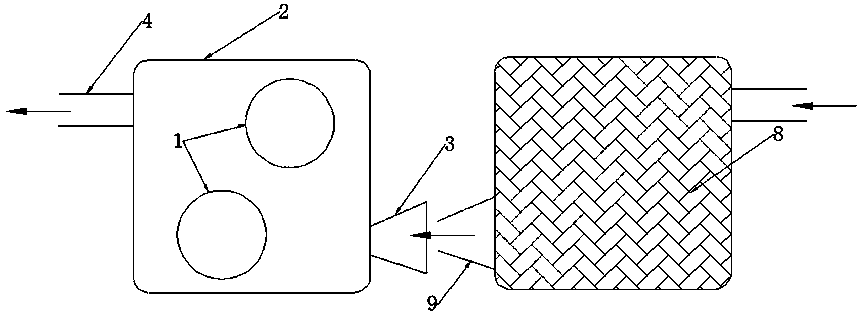
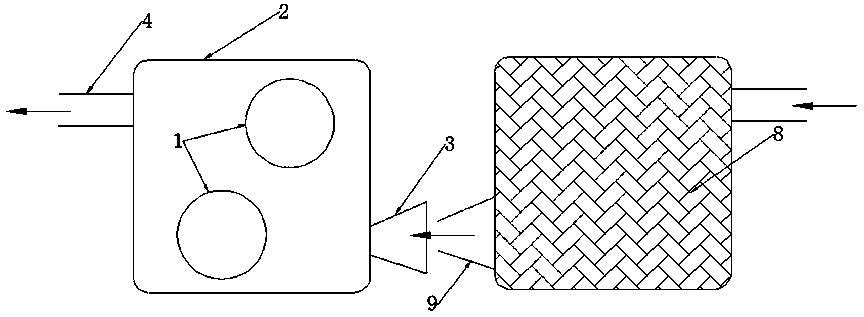
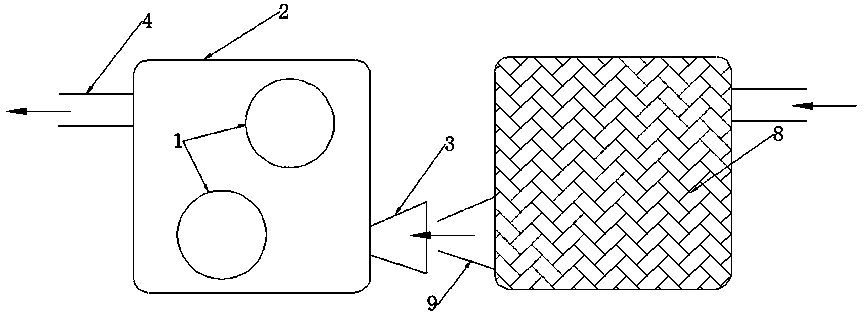
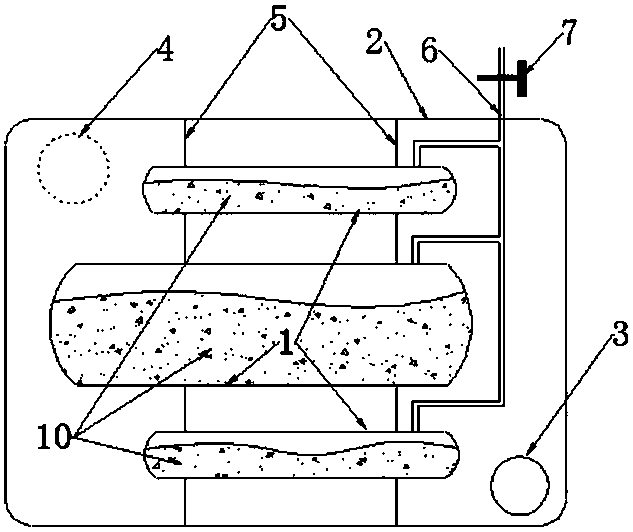
Figure 1 is the side chart of of of the present utility model.
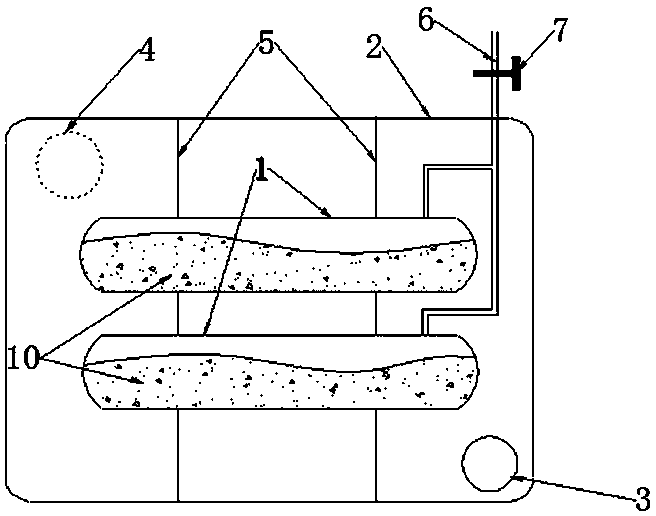
Figure 2 is the positive chart of of of the present utility model.
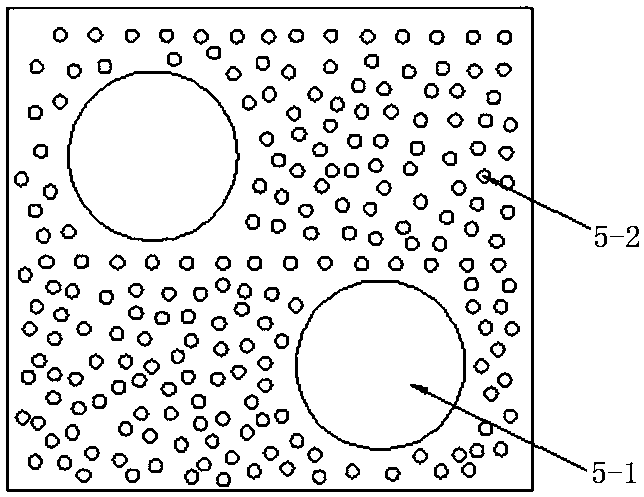
Figure 3 is the fixed baffle structure chart of the of the present utility model.
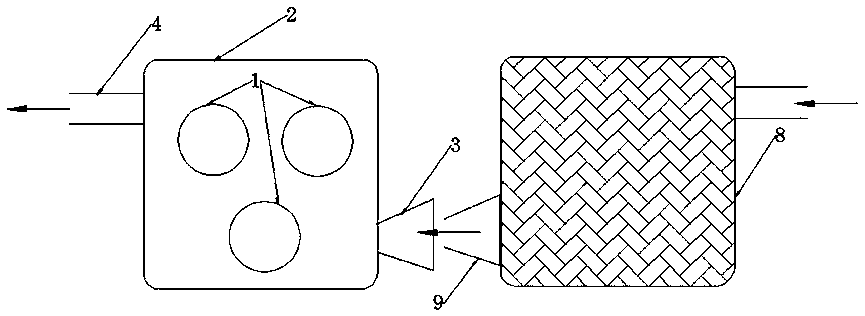
Figure 4 is the side schematic view of three chu of of ammonia pot of the present utility model.
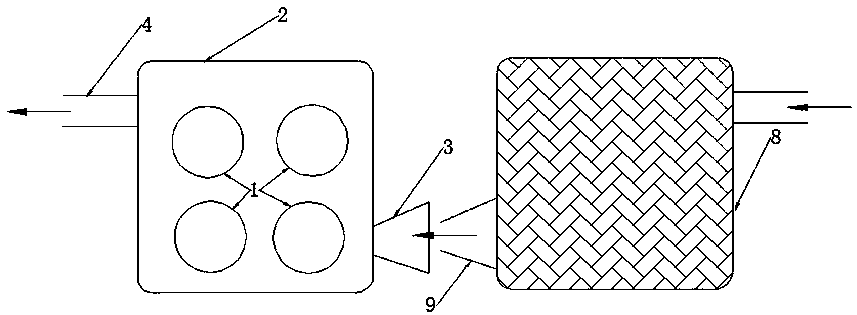
Figure 5 is the side schematic view of four of the [...] of the present utility model.
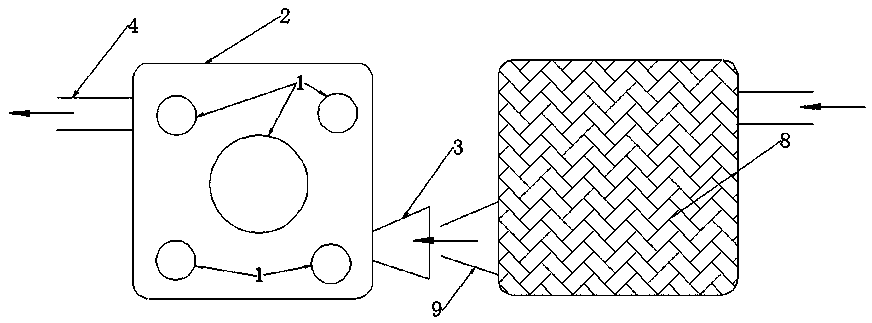
Figure 6 is the side schematic view of the of the five chu anguan of the present utility model.
Figure 7 is the schematic front view of the of the five chu anguan of the present utility model.
Mode of execution
The Figure below to further illustrate the utility model as: as shown in Figure 1-3, a multi-pot entire hot -like SSCR module and a heat removal device, by the [...] 1, entire hot -like SSCR module taking heat from the casing of the device 2, fast interface of the female end 3, heating device exhaust gas outlet 4, the stationary partition 5, the ammonia gas outlet pipe 6, angle valve 7, the exhaust gas post-processor 8, fast interface male end 9 composition, characterized in that two [...] 1 is arranged in the entire hot -like SSCR module taking heat from the casing of the device 2 in the middle of the, two [...] 1 are arranged up and down, through two fixed baffle 5 support, ammonia gas outlet pipe 6 the two [...] 1 connected in parallel, the ammonia gas outlet pipe 6 opening in the outlet end of the whole heating SSCR module taking heat from the casing of the device 2 the top surface, the ammonia gas outlet pipe 6 connected to the canted valve outlet end of 7, from the heat of the exhaust-gas outlet 4 open throughout the heating SSCR module taking heat from the casing of the device 2 of the upper-left, fast interface of the female end 3 is the exhaust-air inlet opening in the whole heating SSCR module taking heat from the casing of the device 2 of the lower right corner, fast interface of the female end 3 to the trumpet shape, the exhaust gas post-processor 8 fast interface male end 9 and fast interface female 3 butt; an ammonia material 10 is filled in the [...] 1 in.
As shown in Figure 4-7, the [...] 1 is cylindrical, both ends of the ellipsoidal-shaped head, can have 5L - 20L of the volume, the tank wall thickness is 2 mm - 4 mm, its shell material by ammonia corrosion resistant aluminum alloy or made of stainless steel, the whole heating SSCR module taking heat from the casing of the device 2 can be arranged in 2 - 5 a [...] 1, the size of the [...] can be equal can also be unequal.
The SSCR module states entire hot -like taking heat from the casing of the device 2 is a cuboid structure, can be made of stainless steel or aluminum alloy, the thickness is 1.5 mm - 2.5 mm, [...] 1 with the outer wall of the whole heating SSCR module taking heat from the casing of the device 2 is a minimum distance between the 20 mm - 50 mm.
The fixed baffle 5, its material can be of stainless steel or aluminum alloy, the thickness is 2.5 mm - 3 mm, the stationary partition 5 [...] with fixed on a corresponding number of 1 of the fixing hole 5 - 1, the stationary partition 5 are uniformly distributed on the vent hole 5 - 2, the vent hole 5 - 2 with a pore size of 5 mm - 10 mm, each fixed baffle 5 upper vent hole for a total area of from the heat of the exhaust gas inlet area 3 - 4 times.
The quick interface of the female end 3 along the exhaust direction of the air flow is gradually reduced diameter, large diameter is 140 - 160 mm, the small diameter is 70 - 90 mm, length of 80 - 100 mm; the mounting for the exhaust gas post-processor 8 fast interface on the male end 9, along the diameter of the exhaust gas flow direction is reduced gradually, large diameter for the 138 - 158 mm and, small diameter is 68 - 88 mm and, length is 80 - 100 mm.
The ammonia gas outlet pipe 6 of the internal diameter of the tube is 0.5 cm - 1.5 cm, wall thickness is 2 mm - 3 mm.
The use of an material 10 can be ammonia or ammonia synthesis of strontium calcium chloride or magnesium chloride or ammonia synthesis with the NH3 chloride to form a complex.
A double-pot entire hot -like SSCR [...] module and a heat removal device, suitable for 3 L displacement of light trucks, is installed in the exhaust gas after the rear end of the processor; in order to ensure the full heating SSCR [...] module taking heat from the safety of the device, [...] 1 is stainless steel or aluminum alloy material of the pressure tank, and the wall thickness of the tank body 2 - 3 mm, cylindrical, and both ends of the ellipsoidal-shaped head. The size of the two [...] can be the same, can also be one large and one small, wheat koji is the volume of the volume of the tentacle and 3 - 4 times, [...] 1 through the fixed baffle plate 5 is fixed to the inside of the heat removal device. Heating device for making flow is to 40% ammonia tank volume of ammonia material 10 prior has already welded into one end of the ammonia in the tank head, and then welding the other end of the [...] head; then the two [...] is inserted into the fixing plate 5 of the prepared hole, the two partitions are respectively positioned at the chu anguan axis to the length of the 1/4 and 3/4 at, then welding ammonia tank wall and the stationary partition 5 the contact part of the; next the [...] and fixed baffle assembly is put in the whole heating SSCR module taking heat from the casing of the device 2 in, subsequently welded and fixed baffle plate and the contact part of the casing and a heat removal device; then, install the two [...] ammonia gas outlet pipe 6, the ammonia gas outlet pipe shall interface are both located on the top side of the [...], the two domestic remittance to the top of the pulled casing and an air outlet pipe, and from the entire hot -like SSCR module taking heat from the casing of the device 2 from the reservation on the hole, and then installed in the pipe angle valve 7, for sealing the ammonia outlet pipe 6 and the whole heating SSCR module taking heat from the casing of the device 2 the contact portions of the sealing; finally, the two sides of the shell and a heat removal device in the end of the welding is complete.
For the convenience of assembly and disassembly, the exhaust gas post-processor fast interface male end 9 and a heat removal device with fast interface of the female end 3 by matching the size of the different diameters of the quick inserting pipe. Heating device installed only by moving the heat removal device, so that the fast interface female 3 fast with the post-processor on the interface of the male end 9 are inserted together, and a heat removal device can be fixed to the bracket on the frame of the vehicle, the process saves the mounting flange.
The use of engine exhaust gas to [...] 1 to enclosed heating, the exhaust air temperature usually in 150 °C -350 °C. From the exhaust gas after the processor 8 of the exhaust gas discharged by the heat removal device fast interface of the female end 3 into the full heating SSCR module taking heat from the casing of the device 2 in, flows through the [...] 1 and entire hot -like SSCR module taking heat from the casing of the device 2 in the area between, and from the exhaust-gas outlet 4 discharge, thereby realizing the exhaust gas to [...] of enclosed heating, storing the ammonia in the tank when the ammonia desorption temperature of material to reach the, release of ammonia by ammonia gas outlet pipe derived and enter the system of the next unit. Device when in normal use, angle valve is in the open state, when the device needs to be replaced when the ammonia gas in the exhaustion, angle valve closed.
The active gas of ammonia gas access and adsorption is achieved by ammonia gas outlet pipe 6 of the. Can adopt the high-purity industrial ammonia bottle, in ventilation under the environment of natural well-ventilated, through the pressure reducing valve and drying system, in the 0.2 - 0.4 mpa pressure within the outlet of the slow pace of sufficient ammonia, sufficient ammonia time is 2 - 3 H-; sufficient ammonia takes the ammonia in the front and the rear of the weighing device, recognizing the ammonia into the net quality within a predetermined range, after the completion of sufficient ammonia, the closing of the valve of the whole system, to ensure that the leakage does not occur.
This device is suitable for the displacement of the engine 3 L of light trucks, double-pot entire hot -like SSCR module and a heat removal device is mounted on the rear side of the processor after the SCR. According to the NH3 SCR post-processor to set up with demand [...] volume relationship between the mileage. For example, the double-tank total volume of 40 L of the storage tank 100% after sufficient ammonia, for 3 L SCR system of the engine, can be continuous driving 12000 - 15000 km.
As shown in Figure 4, according to need in the whole heating SSCR module taking heat from the casing of the device 2 is arranged in the three [...] 1 when, three [...] 1 can be the same as the size of the, can also be a major and two minor, wheat koji is the volume of the volume of the tentacle and 3 - 4 times, [...] 1 through the fixed baffle plate 5 is fixed to the inside of the heat removal device.
As shown in Figure 5, according to the needs of the SSCR throughout the heating module taking heat from the casing of the device 2 are arranged in the four [...] 1 when, four [...] 1 can be the same as the size of the, can also be a major and two minor, two major two small, wheat koji is the volume of the volume of the tentacle and 3 - 4 times, [...] 1 through the fixed baffle plate 5 is fixed to the inside of the heat removal device.
As shown in Figure 6, 7 is shown, according to the needs of the SSCR throughout the heating module taking heat from the casing of the device 2 is arranged in the five [...] 1 when, five [...] 1 can be the same as the size of the, can also be a large four small, two large and three small, wheat koji is the volume of the volume of the tentacle and 3 - 4 times, [...] 1 through the fixed baffle plate 5 is fixed to the inside of the heat removal device.
Full hot type SSCR module of multiple tank get heat facility











 400-4929-0909
 contact@catarc.com.cn