Disclosure of Invention
The invention aims to provide a lifting device and a vehicle, which can improve the stability of parts in the transmission process and effectively relieve the shaking of the parts after the parts are transmitted in place, thereby improving the production efficiency.
To achieve the purpose, the invention adopts the following technical scheme:
the overhead hoist for with the part overhead hoist from first station to second station, include:
the two ends of the transmission mechanism are respectively positioned above the first station and the second station;
the tray mechanisms are horizontally connected with the transmission mechanism at intervals, each tray mechanism comprises a base plate, an X-direction limiting piece, a Y-direction limiting piece and a Z-direction limiting piece, one side of each base plate is connected with the transmission mechanism so as to be driven by the transmission mechanism to move, the other side of each base plate is connected with the X-direction limiting piece, the Y-direction limiting piece and the Z-direction limiting piece, the Z-direction limiting pieces hook the parts so as to move the parts from the first station to the second station, the X-direction limiting pieces can be abutted against the parts so as to limit the shaking of the parts along the moving direction, and the Y-direction limiting pieces are clamped with the parts so as to limit the shaking of the parts in the horizontal plane and perpendicular to the moving direction;
the in-place clamping mechanism is arranged below one end, close to the second station, of the transmission mechanism and can clamp the part.
Optionally, the substrate includes first connecting portion and second connecting portion, first connecting portion upside is connected transport mechanism, the both ends of second connecting portion with the both ends of first connecting portion are the angle setting of predetermineeing, Y to the locating part with Z to the locating part connect in second connecting portion, so that the width direction of part is less than 90 with the contained angle of direction of movement.
Optionally, the tray mechanism further includes a plurality of interconnect's connecting piece, Y to the locating part with Z all is equipped with a plurality of to the locating part, Y to the locating part with Z to the locating part pass through a plurality of the connecting piece connect in the both ends of second connecting portion, the connecting piece is L type.
Optionally, the Z-direction limiting parts are at least two, the two Z-direction limiting parts are respectively arranged at two ends of the second connecting part, and the Y-direction limiting parts are at least four, so that both sides of the Z-direction limiting parts are respectively provided with the Y-direction limiting parts.
Optionally, the tray mechanism further includes a supporting seat, the X-direction limiting parts are connected to the lower side of the substrate through the supporting seat, at least two X-direction limiting parts are provided, and the two X-direction limiting parts are symmetrically arranged along the length direction of the second connecting portion.
Optionally, the tray mechanism further comprises a spacer, and the connecting end face of the connecting piece and the connecting end face of the supporting seat are respectively provided with a plurality of spacers, so that the supporting positions of the X-direction limiting piece, the Y-direction limiting piece and the Z-direction limiting piece can be adjusted by increasing or decreasing the number of the spacers.
Optionally, the clamping mechanism that targets in place is equipped with two at least, two the clamping mechanism that targets in place symmetry locates the both sides of direction of movement, the clamping mechanism that targets in place includes base, clamping assembly and supporting component, the bottom surface is located to base one end, supporting component with clamping assembly connect in the other end of base, supporting component with clamping assembly cooperation is in order to press from both sides tight part.
Optionally, the clamping assembly comprises a first swing cylinder and a first clamping jaw, wherein a fixed part of the first swing cylinder is connected to the base, and the first clamping jaw is connected to a rotating part of the first swing cylinder;
the support assembly comprises a second swing cylinder and a second clamping jaw, wherein the fixed part of the second swing cylinder is connected with the base, and the second clamping jaw is connected with the rotating part of the second swing cylinder.
Optionally, the one end of first clamping jaw is connected first swing cylinder, the one end of second clamping jaw is connected the second swing cylinder, the other end of first clamping jaw with the other end of second clamping jaw can the butt produce clamping force in order to press from both sides tightly the part, first clamping jaw with all be equipped with first locating part on the second clamping jaw, the correspondence is equipped with the second locating part on the base, first locating part can with the second locating part counterpoint cooperation, in order to restrict clamping force.
Optionally, the base includes two footstands and connecting plate, the both ends of connecting plate are connected respectively in two the footstands, first swing cylinder with the second swing cylinder connect in the connecting plate downside, just first swing cylinder with the second swing cylinder sets up in opposite side by side, in order to reduce the length along the direction of movement of clamping mechanism that targets in place.
Optionally, the in-place clamping mechanism further comprises a sensor, wherein the sensor is arranged on the first clamping jaw or the second clamping jaw, so that the position and/or the type of the part can be detected through the sensor after clamping.
Optionally, a plurality of lightening holes are formed in the substrate.
Optionally, the device further comprises a read-write mechanism, wherein the read-write mechanism is arranged at one end of the transmission mechanism, which is close to the first station and the second station, and can identify the parts on the in-place clamping mechanism.
The vehicle comprises the part, and the part is hoisted through the hoisting device, so that the part moves from the first station to the second station.
The beneficial effects are that:
according to the lifting device, the power for driving the part to move from the first station to the second station is provided through the transmission mechanism; a plurality of tray mechanisms are horizontally arranged at intervals on the lower side of the transmission mechanism, one side of a substrate of each tray mechanism is connected with the transmission mechanism, and the other side of the substrate is provided with an X-direction limiting part, a Y-direction limiting part and a Z-direction limiting part, wherein the Z-direction limiting part is used for hooking parts so as to be capable of lifting the parts and limiting the parts in the vertical direction; after the parts are hooked, the X-direction limiting piece is abutted against one side of the parts, so that shaking of the parts in the moving direction can be reduced, the Y-direction limiting piece is clamped with the parts, shaking of the parts in the horizontal plane along the direction perpendicular to the moving direction is reduced, stable transmission in the vertical direction and the horizontal direction in the part lifting process is realized through the Z-direction limiting piece, the X-direction limiting piece and the Y-direction limiting piece, and the problem of collision damage among the parts is solved; the device is also provided with an in-place clamping mechanism, so that shaking of parts when the parts enter the next station is further reduced, the problem that the parts are difficult to grasp after being in place is solved, and the production efficiency is improved.
According to the vehicle provided by the invention, the lifting device is used for lifting the parts, so that the stable transmission of the parts for vehicle assembly is realized, and the production efficiency of the vehicle is improved.
Detailed Description
The invention is described in further detail below with reference to the drawings and examples. It is to be understood that the specific embodiments described herein are merely illustrative of the invention and are not limiting thereof. It should be further noted that, for convenience of description, only some, but not all of the structures related to the present invention are shown in the drawings.
In the description of the present invention, unless explicitly stated and limited otherwise, the terms "connected," "connected," and "fixed" are to be construed broadly, and may be, for example, fixedly connected, detachably connected, or integrally formed; can be mechanically or electrically connected; can be directly connected or indirectly connected through an intermediate medium, and can be communicated with the inside of two elements or the interaction relationship of the two elements. The specific meaning of the above terms in the present invention will be understood in specific cases by those of ordinary skill in the art.
In the present invention, unless expressly stated or limited otherwise, a first feature "above" or "below" a second feature may include both the first and second features being in direct contact, as well as the first and second features not being in direct contact but being in contact with each other through additional features therebetween. Moreover, a first feature being "above," "over" and "on" a second feature includes the first feature being directly above and obliquely above the second feature, or simply indicating that the first feature is higher in level than the second feature. The first feature being "under", "below" and "beneath" the second feature includes the first feature being directly under and obliquely below the second feature, or simply means that the first feature is less level than the second feature.
In the description of the present embodiment, the terms "upper", "lower", "right", etc. orientation or positional relationship are based on the orientation or positional relationship shown in the drawings, and are merely for convenience of description and simplicity of operation, and do not indicate or imply that the apparatus or elements referred to must have a specific orientation, be constructed and operated in a specific orientation, and thus should not be construed as limiting the invention. Furthermore, the terms "first," "second," and the like, are used merely for distinguishing between descriptions and not for distinguishing between them.
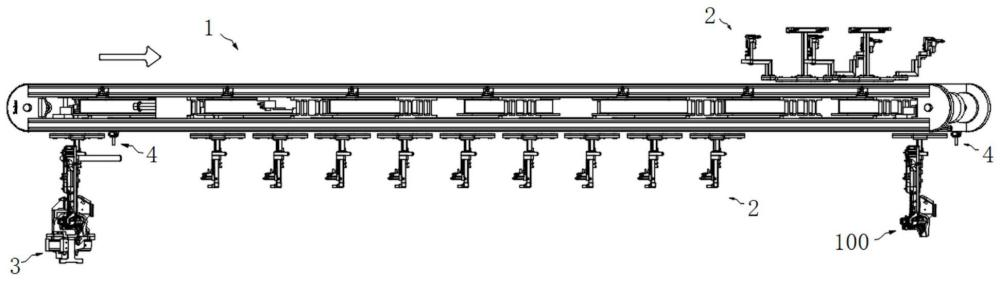
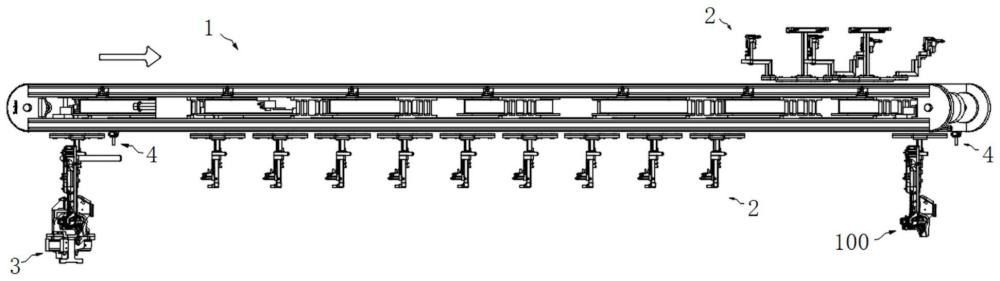
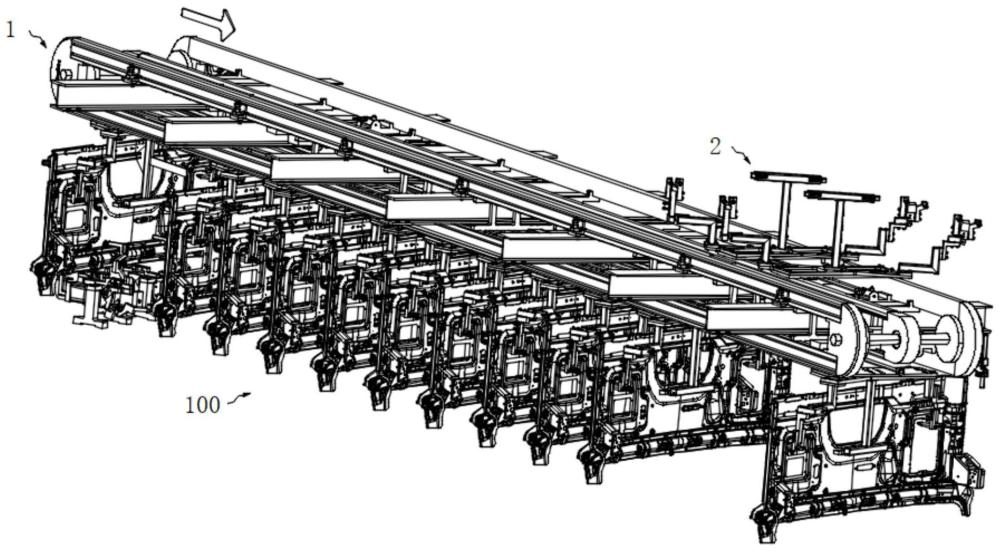
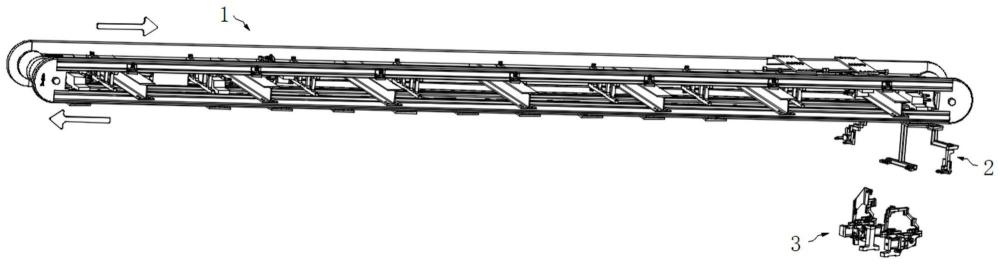
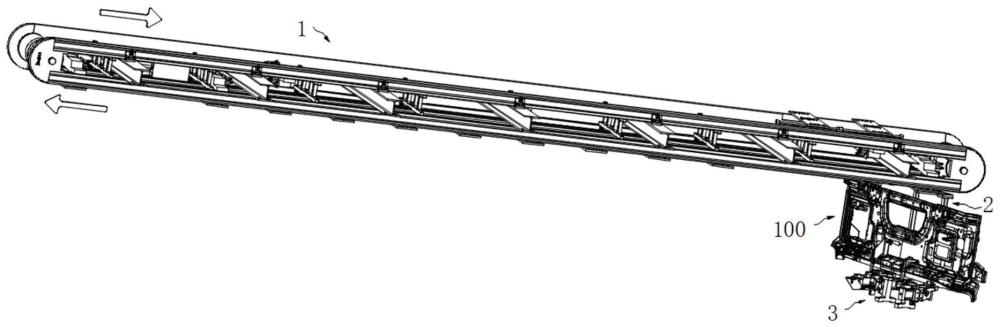
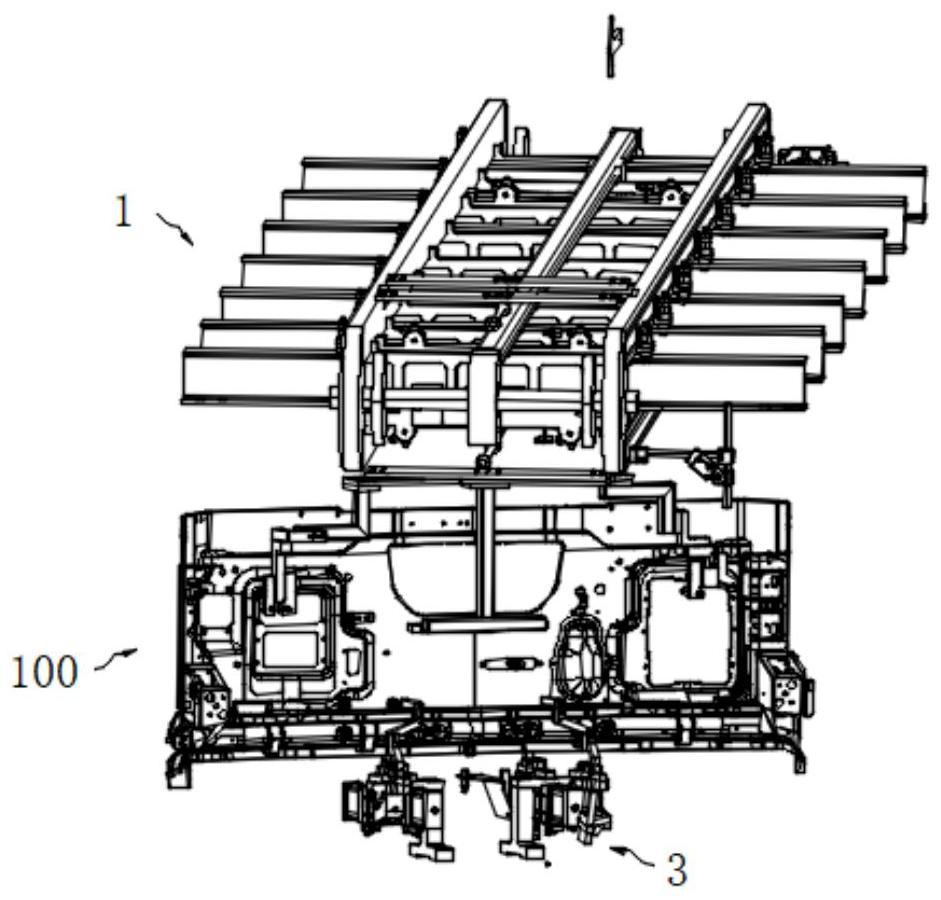
As shown in fig. 1-5, the present embodiment provides a handling device (hereinafter simply referred to as "device") for handling a part 100 from a first station to a second station. The device comprises a transmission mechanism 1, a plurality of tray mechanisms 2 and an in-place clamping mechanism 3, wherein two ends of the transmission mechanism 1 are respectively positioned above a first station and a second station; the tray mechanisms 2 are horizontally connected to the transmission mechanism 1 at intervals, the tray mechanisms 2 comprise a base plate 21, an X-direction limiting piece 22, a Y-direction limiting piece 23 and a Z-direction limiting piece 24, one side of the base plate 21 is connected with the transmission mechanism 1 so as to be driven by the transmission mechanism 1 to move, the other side of the base plate 21 is connected with the X-direction limiting piece 22, the Y-direction limiting piece 23 and the Z-direction limiting piece 24, the Z-direction limiting piece 24 hooks the part 100 so as to move the part 100 from a first station to a second station, the X-direction limiting piece 22 can abut against the part 100 so as to limit the shaking of the part 100 along the moving direction, and the Y-direction limiting piece 23 is clamped with the part 100 so as to limit the shaking of the part 100 in a horizontal plane and perpendicular to the moving direction; the in-place clamping mechanism 3 is arranged below one end of the transmission mechanism 1 close to the second station and can clamp the part 100.
The device provides power for driving the part 100 to move from the first station to the second station through the transmission mechanism 1. Specifically, the transmission mechanism 1 is driven by a SEW motor to realize cross-channel transmission; the transmission mechanism 1 comprises a transmission chain, the length of the transmission chain is 8660mm, the transmission speed is 8.3mm/min, and the repeated positioning accuracy is +/-0.5 mm. Preferably, the transmission mechanism 1 may be an APC accumulation chain, or may be other structures that can perform a transmission function, and in view of existing structures, detailed structures thereof will not be repeated here. The transmission mechanism 1 downside is equipped with a plurality of tray mechanism 2, and a plurality of tray mechanism 2 horizontal interval sets up to enable every tray mechanism 2 homoenergetic to correspond and bear a part 100, realize the purpose of transmission part 100 in batches, increase part 100 buffer memory quantity, raise the efficiency and degree of automation. Specifically, the transmission chain can drive 12 groups of tray mechanisms 2 to do linear and overturning motions, the distance between every two adjacent tray mechanisms 2 can be 600mm to provide storage space of parts 100, the transmission chain can provide 19min of part 100 buffer for coping with line fault stop, and the reduction of the mobility caused by the line fault stop is reduced, so that the influence on the production efficiency is caused; buffer damping mechanisms can be arranged between different tray mechanisms 2 to ensure the stable operation of the tray mechanisms 2 and reduce the risk of collision of the parts 100. Preferably, the dimensions of the tray mechanism 2 may be 1115mm x 955mm x 466mm.
Specifically, the tray mechanism 2 is connected with the transmission mechanism 1 through one side of the substrate 21, so that the tray mechanism 2 is connected with the transmission mechanism 1; the other side of the base plate 21 is provided with an X-direction limiting piece 22, a Y-direction limiting piece 23 and a Z-direction limiting piece 24. The Z-direction limiting member 24 is used for hooking the part 100, so as to be capable of lifting the part 100, thereby limiting the part 100 in a vertical direction. Further, the Z-direction limiting member 24 may include a hooking surface or hooking groove for reliably hooking the component 100. After the hooking of the part 100 is realized through the Z-direction limiting piece 24, the part 100 is arranged at intervals with the ground, the transmission mechanism 1 can drive the part 100 to move, and in order to improve the stability of the part 100 in the transmission process, the lower side of the base plate 21 is also provided with an X-direction limiting piece 22 and a Y-direction limiting piece 23. In this embodiment, the part 100 includes an abutment surface perpendicular to the moving direction and a limiting structure for clamping, where the limiting structure may be a limiting hole or a limiting slot; preferably, the part 100 is a cowl assembly part. The X-direction limiting member 22 abuts against the abutment surface of the component 100 to reduce the shake of the component 100 in the moving direction; the Y-direction limiting member 23 engages with a limiting mechanism of the component 100 or engages with both ends of the component 100 perpendicular to the moving direction, thereby reducing the shake of the component 100 in the horizontal plane along the direction perpendicular to the moving direction. The tray mechanism 2 can be said to realize vertical direction limitation through the Z-direction limiting member 24, front-rear direction limitation through the X-direction limiting member 22, and left-right direction limitation of the part 100 through the Y-direction limiting member 23, thereby realizing stable transmission of the part 100 in multi-angle limitation in the lifting process and alleviating collision damage caused by shaking of adjacent parts 100. The device is also provided with an in-place clamping mechanism 3, and the in-place clamping mechanism 3 is arranged below the transmission mechanism 1 and close to the second station and used for stabilizing the part 100 which is transmitted, further reducing the shaking of the part 100 when entering the next station, further relieving the problem of difficulty in grabbing the part 100 after in place and further improving the production efficiency.
Preferably, the flatness requirement of the substrate 21 is 0.02/1000mm, and the maximum is not more than 0.1mm; the thickness of the substrate 21 is preferably 15mm; yellow paint is sprayed on the skirt edge of the base plate 21 and golden yellow paint is sprayed on the assembling surface so as to be convenient for recognition during assembling.
Optionally, the device further comprises a read-write mechanism 4, wherein the read-write mechanism 4 is arranged at one end of the transmission mechanism 1 near the first station and the second station, and can identify the part 100 on the clamping mechanism 3.
The read-write mechanism 4 comprises an FRID read-write system, an identification tag can be arranged on the part 100, and the identification tag is written or read through the FRID read-write system so as to acquire the information of the part 100, thereby ensuring the correctness of the transmission positions of different parts 100 and ensuring the reliable running of the vehicle assembly. Specifically, the transmission mechanism 1 can be arranged close to the first station and the second station and provided with the read-write mechanism 4 so as to write in the vehicle type information at the first station and read the vehicle type information at the second station, accurately identify the information of the part 100 entering or outputting the device, and the transmission condition of the part 100 can be conveniently checked through the arrangement of the read-write mechanisms 4 at two ends.
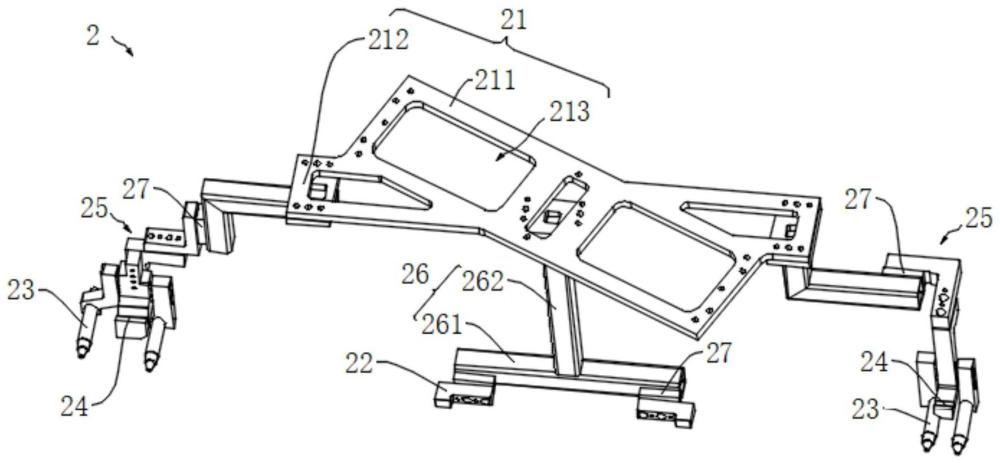
As shown in fig. 1 to 6, optionally, the substrate 21 includes a first connecting portion 211 and a second connecting portion 212, the upper side of the first connecting portion 211 is connected to the transmission mechanism 1, two ends of the second connecting portion 212 and two ends of the first connecting portion 211 are arranged at a preset angle, and the Y-directional limiting member 23 and the Z-directional limiting member 24 are connected to the second connecting portion 212, so that an included angle between the width direction and the moving direction of the part 100 is smaller than 90 °.
The first connecting portion 211 and the second connecting portion 212 may be integrally formed, so as to ensure that the extending directions of the two ends of the length of the second connecting portion 212 are set at a preset angle with the extending direction of the length of the first connecting portion 211. After the substrate 21 is assembled, due to the arrangement of the second connecting portion 212, the contact surface and the moving direction of the part 100 are enabled to be smaller than 90 ° after hooking, so that the influence of factors such as wind resistance can be reduced in the moving process, which is not only helpful for ensuring the moving speed, but also reducing the risks such as shaking, colliding and falling caused by overlarge wind resistance.
Optionally, the base plate 21 is provided with a plurality of lightening holes 213.
Since the conveying mechanism 1 needs to drive the tray mechanism 2 to move, the weight reducing holes 213 are formed in the tray mechanism 2, so that the load can be reduced. Specifically, the positions where the first connection portion 211 and the second connection portion 212 need to be connected are solid structures, and on the premise of ensuring sufficient strength, a plurality of lightening holes 213 may be formed, so that the substrate 21 is in a frame structure.
Optionally, the tray mechanism 2 further includes a plurality of connecting pieces 25 connected to each other, the Y-directional limiting pieces 23 and the Z-directional limiting pieces 24 are both provided with a plurality of Y-directional limiting pieces 23 and Z-directional limiting pieces 24, and the Y-directional limiting pieces 23 and the Z-directional limiting pieces 24 are connected to two ends of the second connecting portion 212 through the plurality of connecting pieces 25, where the connecting pieces 25 are L-shaped.
The Y-directional stoppers 23 and the Z-directional stoppers 24 may be symmetrically disposed at two ends of the second connection portion 212, or the positions of the Y-directional stoppers 23, the Z-directional stoppers 24, and the relative positions of the Y-directional stoppers 23 and the Z-directional stoppers 24 may be different from each other at two ends of the second connection portion 212 according to the structure of the component 100, so as to achieve hooking and limiting of the component 100. The Y-directional limiting member 23 and the Z-directional limiting member 24 may be connected to the end of the second connecting portion 212 through a plurality of connecting members 25. Further, by setting the connection positions between the different connection members 25 and the number of the connection members 25, preliminary determination of the positions of the Y-direction stopper 23 and the Z-direction stopper 24 with respect to the substrate 21 is achieved. The L-shaped connecting piece 25 is adopted, so that the space position adjustment of the Y-direction limiting piece 23 or the Z-direction limiting piece 24 is conveniently realized by connecting different surfaces, a larger connecting surface is conveniently provided, and the reliability of connection is ensured. Preferably, the connection member 25 may be positioned by a pin, by a bolt or screw connection, such as a two pin structure.
Optionally, at least two Z-directional limiting members 24 are provided, and two Z-directional limiting members 24 are respectively provided at two ends of the second connecting portion 212, and at least four Y-directional limiting members 23 are provided, so that two sides of the Z-directional limiting members 24 are provided with Y-directional limiting members 23.
Because the Z-direction limiting member 24 is used for hooking the part 100, which is a main structure of the lifting part 100, the single Z-direction limiting member 24 can achieve the purpose of hooking, but the force is large and the stability is not easy to be ensured. The device is provided with two Z-direction limiting pieces 24 and reliably hooks the part 100, and the part 100 is considered to move left and right on the Z-direction limiting pieces 24 along the direction perpendicular to the moving direction, and Y-direction limiting pieces 23 are arranged on two sides of each Z-direction limiting piece 24, so that the left and right limiting effect is realized on the hooking position of each part 100, and left and right shaking is avoided. It will be appreciated that the number of the Z-direction limiting members 24 and the Y-direction limiting members 23 and the relative positions thereof may be determined according to practical situations. Specifically, the Z-direction stopper 24 may have a trapezoidal block structure to ensure sufficient strength; the Y-direction stopper 23 has a pin-like structure, so that it can be easily inserted into the stopper structure of the component 100 or can be engaged with both left and right ends of the component 100. The rear sides of the Z-direction limiting piece 24 and the Y-direction limiting piece 23 along the moving direction are provided with connecting pieces 25, so that when the part 100 is driven to move, the part 100 can be abutted against the connecting pieces 25 due to inertia, and the part 100 is prevented from slipping due to the inertia; the clamping structure can also be arranged on the Z-direction limiting piece 24 and/or the Y-direction limiting piece 23, so that unexpected slipping when the part 100 is driven is avoided; the clamping structure can be a clamping block, a clamping groove and the like.
Optionally, the tray mechanism 2 further includes a supporting seat 26, the X-directional limiting members 22 are connected to the lower side of the base plate 21 through the supporting seat 26, at least two X-directional limiting members 22 are provided, and the two X-directional limiting members 22 are symmetrically disposed along the length direction of the second connecting portion 212.
The support base 26 may include a support cross bar 261 and a support longitudinal bar 262, one end of the support longitudinal bar 262 is connected to the substrate 21, and the other end is connected to the support cross bar 261, so that the support structure can realize a connection supporting function, and simultaneously reduce the volume and the weight. The supporting seat 26 can be fastened and connected with the base plate 21 through 4M 10 bolts; one end of the support rail 262 may be provided with a connection block or a connection surface to increase a connection area with the base plate 21; the other end of the support vertical rod 262 is connected to the middle of the support horizontal rod 261, so that two X-direction limiting members 22 disposed on the support horizontal rod 261 can be symmetrically disposed on two sides of a straight line where the centroid of the substrate 21 is located, that is, along the length direction of the second connecting portion 212, so as to ensure stress balance while reliably abutting against the abutting surface of the part 100, limiting X-direction shaking, preventing the part 100 from colliding with and overturning. The sharp corners of the supporting seat 26 are blunted, burrs are removed, and blackening treatment is carried out on the surfaces so as to avoid scratching the parts 100; the X-direction limiting member 22 has a nylon block structure to prevent the collision of the parts 100.
Optionally, the tray mechanism 2 further includes a spacer 27, and the connection end surface of the connecting member 25 and the connection end surface of the supporting seat 26 are provided with a plurality of spacers 27, so that the supporting positions of the X-direction limiting member 22, the Y-direction limiting member 23 and the Z-direction limiting member 24 can be adjusted by increasing or decreasing the number of the spacers 27.
After the X-direction limiting piece 22, the Y-direction limiting piece 23 and the Z-direction limiting piece 24 are initially limited through the connection of different connecting pieces 25, the X-direction limiting piece 22, the Y-direction limiting piece 23 and the Z-direction limiting piece 24 can be accurately adjusted in the X-direction, the Y-direction and the Z-direction respectively by increasing and decreasing the number of gaskets 27 according to the structure of the part 100, and the part 100 is fixed relative to the tray mechanism 2 through accurate limiting, so that the accurate positioning effect on the part 100 can be reliably realized in the air, and the shaking of the part 100 is limited. For example, the position of the X-direction stopper 22 in the moving direction can be adjusted by adjusting the number of the spacers 27. Specifically, the thickness of the spacer 27 may be a 3mm bi-directional adjustment spacer. The tray mechanism 2 can be fixed by two pin pieces and two screws, and is subjected to quenching treatment to ensure that the surface hardness is greater than or equal to HRC50, blackening treatment is carried out, and rust is prevented.
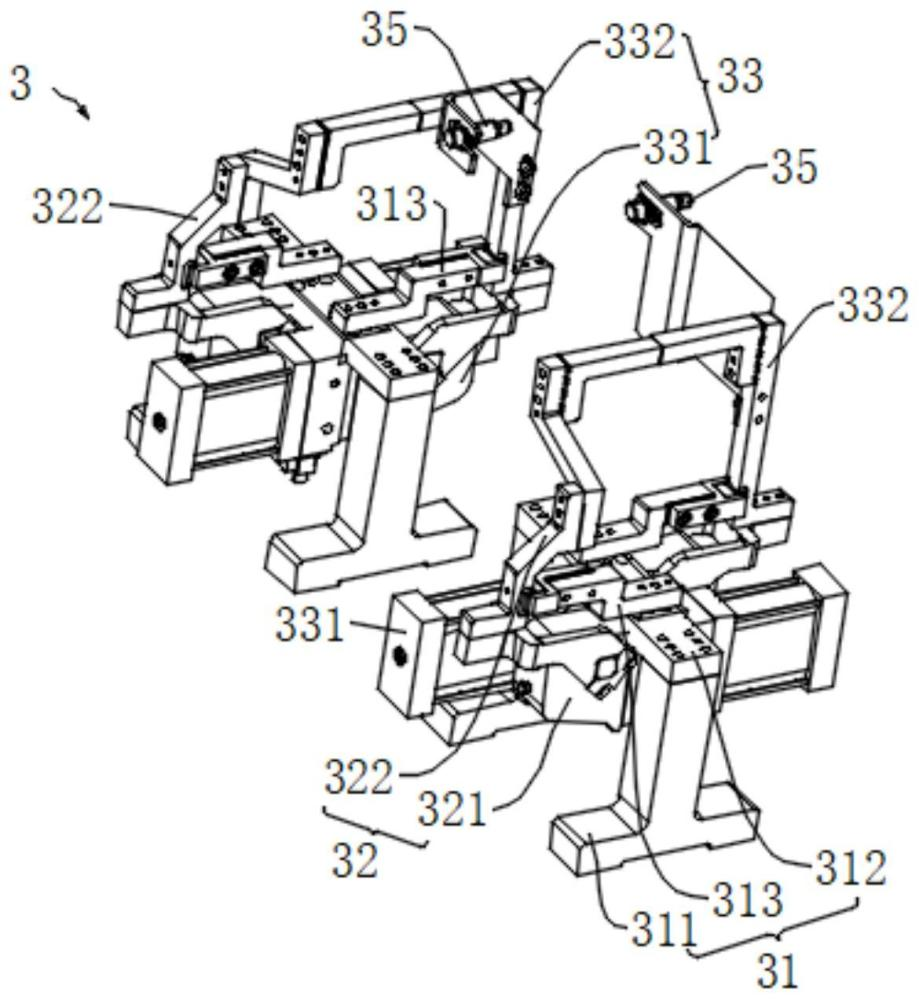
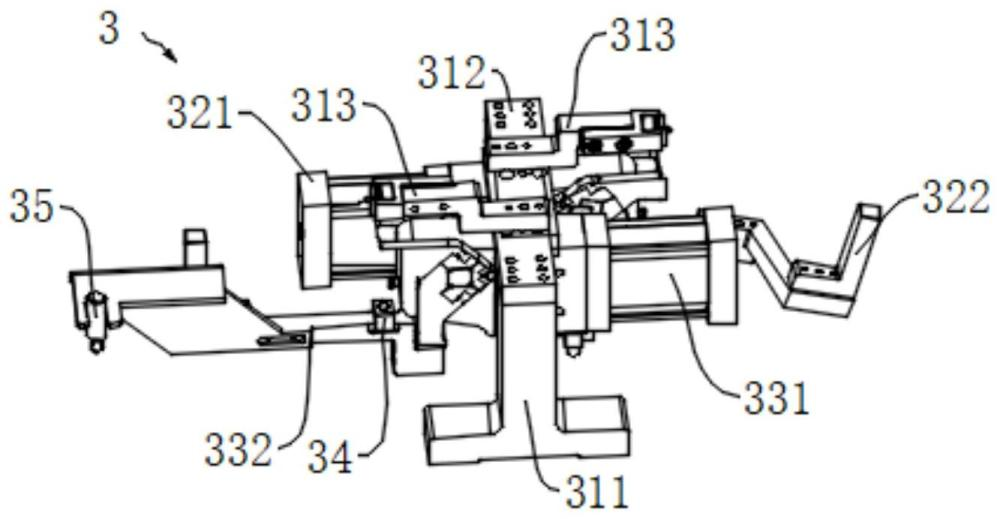
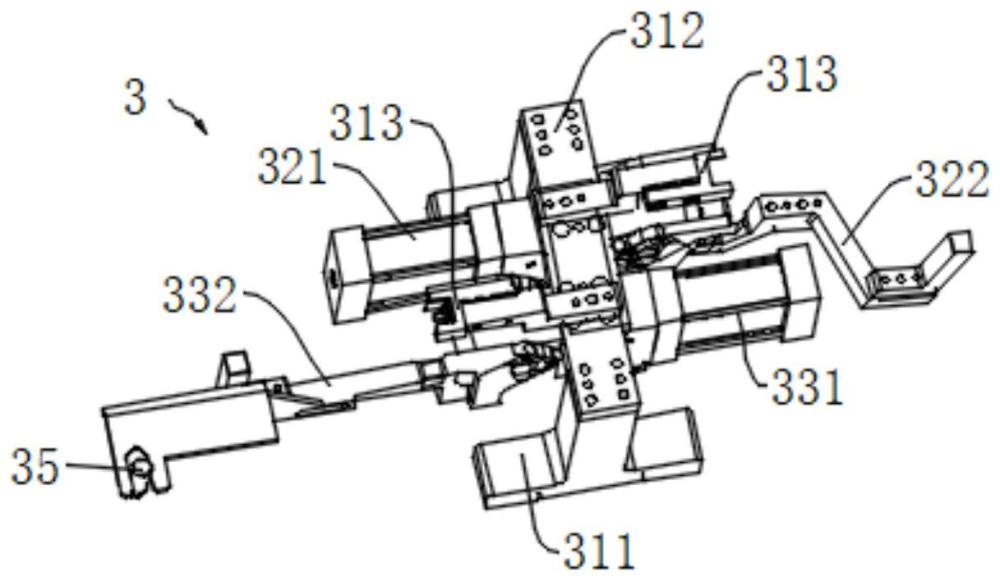
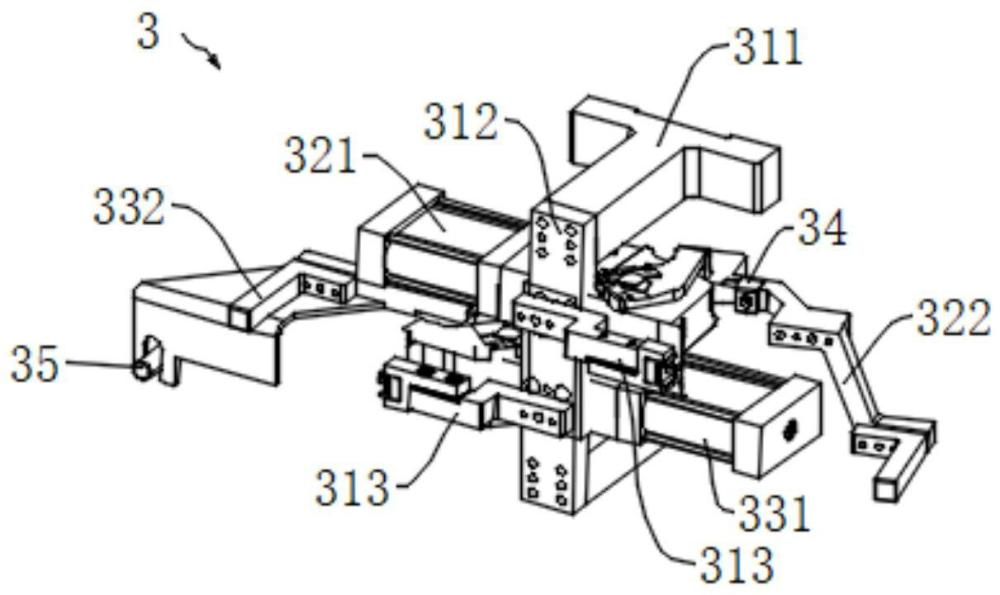
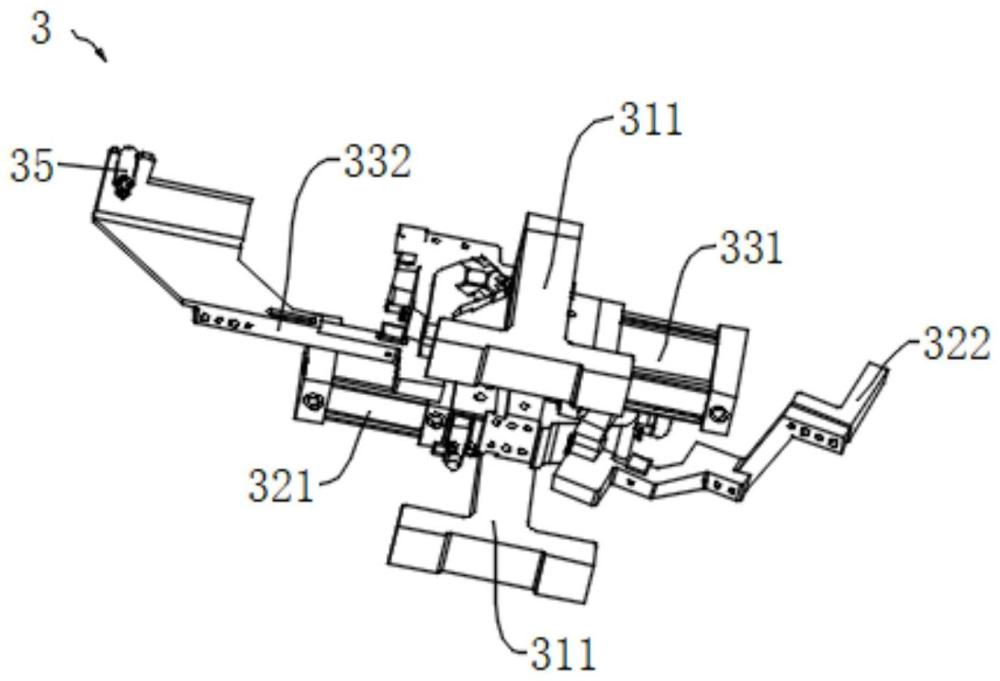
As shown in fig. 1-12, optionally, at least two in-place clamping mechanisms 3 are provided, the two in-place clamping mechanisms 3 are symmetrically arranged at two sides of the moving direction, the in-place clamping mechanism 3 comprises a base 31, a clamping component 32 and a supporting component 33, one end of the base 31 is arranged on the bottom surface, the supporting component 33 and the clamping component 32 are connected to the other end of the base 31, and the supporting component 33 is matched with the clamping component 32 to clamp the part 100.
As shown in fig. 7, the two in-place clamping mechanisms 3 can clamp the left and right ends of the part 100, respectively, so that the part 100 is stabilized at the second station. The in-place clamping mechanism 3 is placed on the ground through the base 31, and the clamping assembly 32 and the supporting assembly 33 are arranged at intervals from the ground, so that the front and rear surfaces of the part 100 can be clamped by the actions such as overturning and the like. Specifically, the clamping assembly 32 and the support assembly 33 can be moved toward each other to a clamped or moved away from each other to an initial state of deployment to enable clamping when the part 100 is moved over the in-place clamping mechanism 3 and to avoid interference by deployment to affect movement of the part 100 when it is desired to transfer to the next station.
As shown in fig. 8 to 12, the base 31 may alternatively include two legs 311 and a connection plate 312, and both ends of the connection plate 312 are connected to the two legs 311, respectively.
The two bases 311 are spaced apart in a direction perpendicular to the moving direction, and the tops of the two bases 311 are connected by a connection plate 312, so that the support assembly 33 and the clamping assembly 32 can be disposed on the connection plate 312. Specifically, the foot stand 311 is integrally wire-cut, and a welding structure is not required, so that the supporting strength can be enhanced.
Alternatively, the clamping assembly 32 includes a first swing cylinder 321 and a first clamping jaw 322, a fixed portion of the first swing cylinder 321 is connected to the base 31, and the first clamping jaw 322 is connected to a rotating portion of the first swing cylinder 321; the support assembly 33 includes a second swing cylinder 331 and a second clamping jaw 332, a fixed portion of the second swing cylinder 331 is connected to the base 31, and the second clamping jaw 332 is connected to a rotating portion of the second swing cylinder 331.
The first clamping jaw 322 and the second clamping jaw 332 may be formed by connecting a plurality of connecting monomers, and the shape and the size of the connecting monomers are not particularly limited, and clamping can be realized according to the shape of the part 100. During clamping, the first clamping jaw 322 is driven to rotate by the rotating part of the first swinging cylinder 321, so that one end of the first clamping jaw 322 far away from the first swinging cylinder 321 is turned over to the upper part of the base 31; similarly, the second clamping jaw 332 acts similarly to the first clamping jaw 322, such that clamping is achieved by the end of the first clamping jaw 322 remote from the first swing cylinder 321 and the end of the second clamping jaw 332 remote from the second swing cylinder 331. Further, by the shape and size of the connecting unit, the clamping action of the part 100 can be achieved by the connecting unit, so that the clamping action of the part 100 can be achieved by the first clamping jaw 322 and the second clamping jaw 332. Preferably, when the connecting units of the first clamping jaw 322 and the second clamping jaw 332 are connected, a plurality of gasket structures can be arranged at the connecting positions, so that the space positions of the first clamping jaw 322 and the second clamping jaw 332 can be accurately adjusted by increasing or decreasing the gasket structures, and clamping of the part 100 can be better realized.
Optionally, one end of the first clamping jaw 322 is connected to the first swing cylinder 321, one end of the second clamping jaw 332 is connected to the second swing cylinder 331, the other end of the first clamping jaw 322 and the other end of the second clamping jaw 332 can be abutted to generate a clamping force to clamp the part 100, the first clamping jaw 322 and the second clamping jaw 332 are respectively provided with a first limiting member 34, the base 31 is correspondingly provided with a second limiting member 313, and the first limiting member 34 can be matched with the second limiting member 313 in an alignment manner so as to limit the clamping force.
Preferably, one of the first limiting member 34 and the second limiting member 313 includes a block structure, and the other includes a groove structure, so that the first clamping jaw 322 and the second clamping jaw 332 cannot continue to clamp after being clamped to a certain degree through the cooperation of the block structure and the groove structure, and the problem of damage to the component 100 caused by excessive clamping force between the first clamping jaw 322 and the second clamping jaw 332 is avoided. Further, one of the block-like structure and the groove-like structure may be provided with a projection, and the other may be provided with a recess, so that a precise positioning fit can be further achieved by the projection and the recess fitting. The first stopper 34 may be shaped, sized, and positioned to mate with the second stopper 313. Specifically, each structure of the in-place clamping mechanism 3 can be positioned through a pin structure, and connected through bolts or screws so as to be convenient to disassemble; the gasket structure can be arranged at the connecting position or the matching position so as to accurately adjust the position and accurately align and match. The arrangement of the gasket 27 and the connecting piece 25 of the tray mechanism 2, the connecting monomer of the in-place clamping mechanism 3, the gasket structure and the like enables the adjustability of the device to be better, and the device can be suitable for parts 100 of various different vehicle types.
Alternatively, the first swing cylinder 321 and the second swing cylinder 331 are connected to the lower side of the connection plate 312, and the first swing cylinder 321 and the second swing cylinder 331 are disposed in opposite sides side by side to reduce the length of the in-place clamping mechanism 3 in the moving direction.
The first swing cylinder 321 and the second swing cylinder 331 are both connected with the connecting plate 312 in the middle, so that the situation that the length of the in-place clamping mechanism 3 along the moving direction is too long due to the fact that the connecting fixing part is far away from one end of the rotating part is avoided, and the space occupation is not reduced. In this embodiment, the first swing cylinder 321 and the second swing cylinder 331 are reversely arranged side by side under the premise of ensuring that the rotation of the rotation part is not interfered, which is helpful for arranging the in-place clamping mechanism 3 in a factory building with smaller space. In addition, the supporting component 33 and the clamping component 32 are matched for clamping, and the tray mechanism 2 is adopted for driving and limiting the part 100, so that the device can be suitable for the parts 100 of various vehicle types, the applicability is improved, and the investment and transformation cost caused by introducing the vehicle types is reduced.
Optionally, the in-place clamping mechanism 3 further comprises a sensor 35, the sensor 35 being provided on the first clamping jaw 322 or the second clamping jaw 332 to detect the position and/or kind of the part 100 after clamping by the sensor 35.
The sensor 35 may be disposed at a predetermined position on the in-place clamping mechanism 3, so as to achieve the purpose of detecting the part 100. Preferably, the sensor 35 comprises an in-place detecting sensor and a part identifying sensor, and since the device comprises at least two in-place clamping mechanisms 3 which are matched with each other, the in-place detecting sensor can be arranged on the second clamping jaw 332 of one supporting component 33, and the part identifying sensor can be arranged on the second clamping jaw 332 of the other supporting component 33, so that whether the part 100 reaches a preset position or not can be detected by the in-place detecting sensor, and the difference of the shapes of the part 100 and the like can be detected by the part identifying sensor to determine the type information of the part 100. The part identification sensor and the read-write mechanism 4 can be matched with each other to jointly realize information identification of the part 100, so that the type of the part 100 is accurately identified, and the problem that the part 100 cannot be transmitted to a corresponding station due to identification errors and the production efficiency is affected is avoided.
The device is also provided with necessary control mechanisms, including a wire PLC, so as to control the actions and the use of the transmission mechanism 1, the read-write mechanism 4, the sensor 35 and the like through programs, thereby ensuring that the device can be stably transmitted and accurately positioned. The operator needs to periodically perform PM (Preventive Maintenance and Productive Maintenance, preventive maintenance and production maintenance) and TPM (Total Productive Maintenance, full-man production maintenance) to check the wear amounts of the Y-directional stopper 23 and the Z-directional stopper 24, etc., wherein the wear amount of the Y-directional stopper 23 is not more than 0.2mm at maximum, and the wear amount of the Z-directional stopper 24 is not more than 0.5mm at maximum, and if the detection is failed, the replacement is required in time, so as to avoid inaccurate spatial positioning of the part 100 due to reduced limiting precision, and further cause the problem that the part 100 cannot be reliably grasped.
When the device is used, the part 100 can be hooked on the tray mechanism 2 at the first station through the preamble robot gripper, and the vehicle type information is written into the identification tag through the read-write mechanism 4; after the hooking and positioning are completed, the gripper withdraws and the part 100 is transmitted to a second station through the transmission mechanism 1; after the part 100 reaches the second station, the part 100 is turned over and clamped through the clamping component 32 and the supporting component 33 of the in-place clamping mechanism 4, the part 100 is fixed, the sensor 35 detects the part 100, feeds back in-place information of the corresponding part 100 to the PLC, reads the vehicle type information through the RFID and transmits the vehicle type information to the next line PLC, and the vehicle type comparison with the next production line is realized; after the comparison is successful, the part 100 is grabbed by the robot gripper, the tray mechanism 2 is overturned and overturned by the transmission chain and is transmitted to the first station, and therefore the transmission of the part 100 in one process is completed.
The present embodiment also provides a vehicle, which includes a part 100, and the part 100 is hoisted by the hoisting device, so that the part 100 moves from a first station to a second station, so as to be assembled to form the vehicle.
The vehicle can be a truck, the overhead hoist adopts a single-layer hoisting mode, the occupied ground space is reduced, and meanwhile, the occupied space of the in-place clamping mechanism 3 arranged on the ground is smaller, so that the device can be suitable for the conditions that the space of a truck factory welding production line is narrow, the height is limited, and the positions of factory upright posts and water vapor pipelines are arranged, and can effectively and reasonably utilize the space while the production efficiency is improved.
It is to be understood that the above examples of the present invention are provided for clarity of illustration only and are not limiting of the embodiments of the present invention. Various obvious changes, rearrangements and substitutions can be made by those skilled in the art without departing from the scope of the invention. It is not necessary here nor is it exhaustive of all embodiments. Any modification, equivalent replacement, improvement, etc. which come within the spirit and principles of the invention are desired to be protected by the following claims.









 400-4929-0909
 contact@catarc.com.cn