当前位置: 首页> 专利交易> 详情页
    待售中

    一种车辆工况模拟系统及应用方法[ZH]

    专利编号: ZL202602280174

    收藏

    拟转化方式: 转让;普通许可;独占许可;排他许可

    交易价格:面议

    专利类型:发明专利

    法律状态:授权

    技术领域:整车系统

    发布日期:2026-02-28

    发布有效期: 2026-02-28 至 2041-06-04

    专利顾问 — 伍先生

    微信咨询

    扫码微信咨询

    电话咨询

    咨询电话

    18273488208

    专利基本信息
    >
    申请号 CN202110626823.5 公开号 CN115219218A
    申请日 2021-06-04 公开日 2022-10-21
    申请人 广州汽车集团股份有限公司 专利授权日期 2024-12-27
    发明人 杨付四;岳双成;韦永亮;刘海波 专利权期限届满日 2041-06-04
    申请人地址 510030 广东省广州市越秀区东风中路448-458号成悦大厦23楼 最新法律状态 授权
    技术领域 整车系统 分类号 G01M17/007
    技术效果 精确性 有效性 有效(授权、部分无效)
    专利代理机构 上海波拓知识产权代理有限公司 31264 代理人 周志中
    专利技术详情
    >
    01

    专利摘要

    本发明公开了一种车辆工况模拟系统,包括与汽车轮毂盘固定连接用以模拟车轮的支撑装置和与所述支撑装置相连能收集所述支撑装置高度数据、载荷数据并改变所述支撑装置高度的控制装置,所述支撑装置包括水平放置用以测量所述支撑装置的载荷的底座、底端横向固定于所述底座能沿所述底座纵向扇形摆动的伸缩件,所述底座与所述伸缩件之间设有指示所述底座与所述伸缩件之间角度的角度表;所述控制装置包括可编程控制器,所述可编程控制器内包含轮胎负荷‑轮胎半径对应关系。本发明还提供一种车辆工况模拟系统的应用方法,应用于如上所述的车辆工况模拟系统。
    展开 >
    02

    专利详情

    技术领域

    本发明涉及汽车测试技术领域,尤其涉及一种车辆工况模拟系统及应用方法。

    背景技术

    汽车研发制造过程中,对样车的标定验证是研发重点工作,其中对整车底盘的试验与验证是重中之重。整车底盘的试验与验证是对悬架以及轮胎工况检测,得到不同载荷下悬架和轮胎的变化,通过对比分析得出研发的质量和改进的方向。业内通行的台架试验和测量过程中,轮胎遮档悬架测量,需要移除或替代,但影响工况状态以及轮胎自身状态(如外倾角)动态监测,这也是行业技术难题。

    前面的叙述在于提供一般的背景信息,并不一定构成现有技术。

    发明内容

    本发明的目的在于提供一种能准确模拟轮胎工况的车辆工况模拟系统及应用方法。

    本发明提供一种车辆工况模拟系统,包括与汽车轮毂盘固定连接用以模拟车轮的支撑装置和与所述支撑装置相连能收集所述支撑装置高度数据、载荷数据并改变所述支撑装置高度的控制装置,所述支撑装置包括水平放置用以测量所述支撑装置的载荷的底座、底端横向固定于所述底座能沿所述底座纵向扇形摆动的伸缩件,所述底座与所述伸缩件之间设有指示所述底座与所述伸缩件之间角度的角度表;

    所述控制装置包括可编程控制器,所述可编程控制器内包含轮胎负荷-轮胎半径对应关系,所述可编程控制器用以收集所述支撑装置的载荷数据并代入所述轮胎负荷-轮胎半径对应关系得出轮胎半径并参照所述轮胎半径改变所述伸缩件高度。

    进一步地,所述伸缩件包括与所述底座连接由所述控制装置控制充气与放气的缸体、由所述缸体内压力驱动相对于所述缸体上下运动的活塞杆、将所述活塞杆与所述汽车轮毂盘固定连接的法兰盘。

    进一步地,所述伸缩件还包括用以测量所述支撑装置高度并将高度数据传递给所述控制装置的高度传感器,所述高度传感器包括固定在所述缸体上的静滑片和固定在所述活塞杆上能随所述活塞杆运动且与静滑片滑动接触的动滑片,所述动滑片与所述静滑片相对位置不同时能向所述控制装置发出不同的电信号。

    进一步地,所述缸体通过旋转销与底座连接,所述缸体能绕所述旋转销的中轴线作纵向扇形摆动。

    进一步地,所述角度表包括固定于所述底座上的刻度板和固定于所述缸体上能随所述缸体摆动的指针,所述刻度板上标有刻度,所述指针的前端指向所述刻度板上的刻度。

    进一步地,所述底座上设有与所述可编程控制器相连用以测量所述支撑装置的载荷数据的载荷传感器。

    进一步地,所述控制装置还包括与所述可编程控制器相连用以向所述缸体内加压的加压泵和用以为所述缸体泄压的泄压阀。

    本发明还提供一种车辆工况模拟系统的应用方法,应用于如上所述的车辆工况模拟系统,包括步骤S1至S3,所述步骤S1为将所述汽车轮毂盘与所述伸缩件连接,由支撑装置模拟轮胎;所述步骤S2为所述可编程控制器收集所述支撑装置的载荷数据和高度数据,并将载荷数据代入所述轮胎负荷-轮胎半径对应关系得出对应轮胎半径并参照所述对应轮胎半径改变所述伸缩件高度;所述步骤S3为记录所述角度表的数据及汽车悬架的数据。

    进一步地,所述步骤S2包括步骤S21至S22,所述步骤S21为所述可编程控制器收集所述支撑装置的载荷数据和高度数据,并将载荷数据代入所述轮胎负荷-轮胎半径对应关系得出所述对应轮胎半径;所述步骤S22为所述可编程控制器比较高度数据和所述对应轮胎半径,并改变所述伸缩件的高度直至所述支撑装置的高度数据等于所述对应轮胎半径。

    进一步地,所述控制装置还包括与所述可编程控制器相连用以向所述缸体内加压的加压泵和用以为所述缸体泄压的泄压阀;所述步骤S22为所述可编程控制器比较高度数据和所述对应轮胎半径,并通过所述加压泵向所述缸体内加压或通过所述泄压阀为所述缸体泄压改变所述伸缩件的高度,直至所述支撑装置的高度数据等于所述对应轮胎半径。

    本发明提供的车辆工况模拟系统,通过支撑装置模拟替代轮胎,在测量中不会遮档悬架,不用频繁拆装轮胎就能直接测量悬架数据;通过内置轮胎负荷-半径方程的可编程控制器,可直接根据车辆负荷调整支撑装置的高度,用以模拟对应半径的轮胎;伸缩件能沿底座纵向摆动,不同于传统的固定式轮胎支架辅助检测,更加符合实际工况;通过角度表对轮胎倾角实时检测,使底盘姿态测量更加方便、直观、准确。

    附图说明

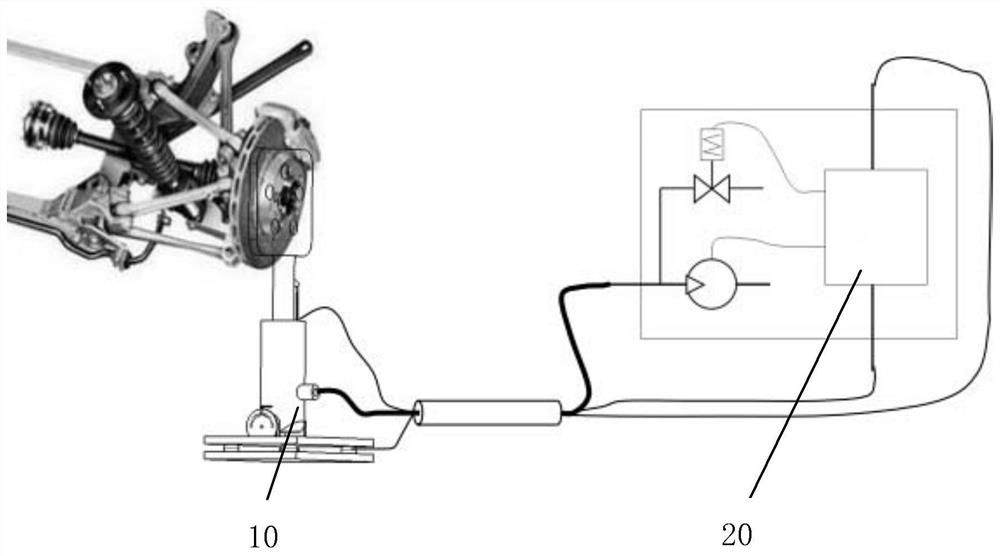
    图1为本发明第一实施例车辆工况模拟系统的结构连接示意图;

    图2为图1所述车辆工况模拟系统中支撑装置的结构示意图;

    图3为图2所述支撑装置中伸缩件在隐藏法兰盘和高度传感器后的结构示意图;

    图4为图2所述支撑装置中底座与旋转销的结构示意图;

    图5为图2所述支撑装置中角度表的结构示意图

    图6为图3所述伸缩件中高度传感器的结构示意图;

    图7为图1所述车辆工况模拟系统中控制装置的连接示意图;

    图8为图7所述控制装置中轮胎负荷-轮胎半径对应关系的方程式图。

    具体实施方式

    下面结合附图和实施例,对本发明的具体实施方式作进一步详细描述。以下实施例用于说明本发明,但不用来限制本发明的范围。

    请参考图1至图8,本发明实施例提供一种车辆工况模拟系统,用于汽车研发制造过程中对整车底盘的试验与验证,包括支撑装置10和与支撑装置10相连的控制装置20。支撑装置10包括底座11、伸缩件12、角度表13,底座11水平放置且底座11上设有测量支撑装置10载荷的载荷传感器111。伸缩件12与底座11相连且能沿底座11纵向扇形摆动,角度表13用以指示伸缩件12与底座11之间所成角度。

    请参考图2至图5,伸缩件12包括缸体121、活塞杆122、法兰盘123和高度传感器124,法兰盘123一端与活塞杆122相连,另一端用以与汽车轮毂盘固定连接。活塞杆122一端伸入缸体121内,缸体121内的压力能驱动活塞杆122相对于缸体121上下运动。缸体121通过旋转销112与底座11相连使得缸体121能绕着旋转销112的中轴线作纵向扇形摆动(如图4所示)。角度表13包括刻度板131和指针132,刻度板131固定于底座11上且垂直于底座11上表面,指针132固定于缸体121上且能随缸体121摆动(如图5所示)。刻度板131上标有用以指示角度的刻度,指针132的前端指向刻度板131上的刻度。

    当指针132随着缸体121摆动时,指针132指向刻度板131上的不同刻度,所指示的刻度即支撑装置10与水平面所成的夹角。支撑装置10与汽车轮毂盘固定连接用以模拟汽车轮胎,通过记录角度表13的刻度,可以记录整车底盘试验中轮胎的外倾角。在其他实施例中,角度表13还可与控制装置20相连,角度表13将角度数据通过模电转换后传递给控制装置20,控制装置20可记录和输出轮胎外倾角数据。

    本实施提供的车辆工况模拟系统,伸缩件12能沿底座11纵向摆动,不同于传统的固定式轮胎支架辅助检测,更加符合实际工况。通过角度表13对轮胎倾角实时检测,使底盘姿态测量更加方便、直观、准确。

    如图6所示,高度传感器124包括静滑片1241和动滑片1242,静滑片1241固定在缸体121上,动滑片1242固定在活塞杆122上且能随活塞杆122上下运动,动滑片1242前端与静滑片1241滑动接触。高度传感器124与控制装置20相连,动滑片1242与静滑片1241相对位置不同时能向控制装置20发出不同的电信号。在控制装置20中预先设置好不同的电信号所代表的高度,即可通过高度传感器124测出支撑装置10的高度,即支撑装置10所模拟的轮胎的半径。

    缸体121上设有连接孔1211,连接孔1211与控制装置20相连,控制装置20可通过连接孔1211控制缸体121内的压力,使活塞杆122能相对缸体121上下运动。在本实施例中,伸缩件12为伸缩气缸,活塞杆122由缸体121内气压驱动,在其他实施例中,伸缩件12也可为液压气缸或其他形式的举升机构。

    如图7所示,控制装置20包括可编程控制器(PLC)21、加压泵22和泄压阀23,加压泵22、泄压阀23均与可编程控制器21和连接孔1211相连。可编程控制器21通过加压泵22增大缸体121内压力,使活塞杆122相对于缸体121向上运动,进而提升支撑装置10的高度;可编程控制器21通过泄压阀23减小缸体121内压力,使活塞杆122相对于缸体121向下运动,进而降低支撑装置10的高度。

    可编程控制器21与载荷传感器111、高度传感器124均相连,载荷传感器111采集的支撑装置10的载荷数据与高度传感器124采集的支撑装置10的高度数据均会传递给可编程控制器21。可编程控制器21内包含轮胎负荷-轮胎半径对应关系,可以通过输入轮胎负荷得出对应的轮胎半径,即载荷传感器111输入载荷数据,通过轮胎负荷-轮胎半径对应关系可计算出对应轮胎半径。可编程控制器21比较对应轮胎半径与高度传感器124输入的高度数据,再通过加压泵22和泄压阀23改变支撑装置10的高度。

    在本实施例中,轮胎负荷-轮胎半径对应关系为线型方程,坐标系如图8所示,横坐标x代表轮胎负荷(Kg),纵坐标y代表轮胎半径(mm)。图8中为某型号轮胎的轮胎负荷-轮胎半径方程,方程式为y=-0.04x+362.4。

    可编程控制器21内可以包含多组轮胎负荷-轮胎半径方程以对应不同型号的轮胎,在整车底盘试验中,可根据实际需求选择对应的轮胎负荷-轮胎半径方程。可编程控制器21还设有人机交互模块(未画出),用以输入新的轮胎负荷-轮胎半径方程和修改现有的轮胎负荷-轮胎半径方程。

    本实施例提供的车辆工况模拟系统,通过支撑装置10模拟替代轮胎,在测量中不会遮档悬架,不用频繁拆装轮胎就能直接测量悬架数据。通过内置轮胎负荷-轮胎半径对应关系的可编程控制器21,可直接根据车辆负荷调整支撑装置10的高度,用以模拟不同半径的轮胎。

    本实施例还提供一种车辆工况模拟系统的应用方法,应用于如上所述的车辆工况模拟系统,包括步骤S1至S3。步骤S1为将汽车轮毂盘与法兰盘123连接,由支撑装置10模拟轮胎。

    步骤S2包括步骤S21和S22,步骤S21为可编程控制器21通过载荷传感器111、高度传感器124收集支撑装置10的载荷数据和高度数据,并将载荷数据代入轮胎负荷-轮胎半径对应关系得出对应轮胎半径。

    步骤S22为可编程控制器21比较对应轮胎半径与高度传感器124输入的高度数据,当高度数据小于对应轮胎半径时,可编程控制器21通过加压泵22增大缸体121内压力,使活塞杆122相对于缸体121向上运动,进而提升支撑装置10的高度,直到高度数据等于对应轮胎半径。当高度数据大于对应轮胎半径时,可编程控制器21通过泄压阀23减小缸体121内压力,使活塞杆122相对于缸体121向下运动,进而降低支撑装置10的高度,直到高度数据等于对应轮胎半径。

    步骤S3为记录角度表13的数据及汽车悬架的数据。

    本实施例提供的车辆工况模拟系统及应用方法,通过支撑装置10模拟替代轮胎,在测量中不会遮档悬架,不用频繁拆装轮胎就能直接测量悬架数据。通过内置轮胎负荷-轮胎半径对应关系的可编程控制器21,可直接根据车辆负荷调整支撑装置10的高度,用以模拟不同半径的轮胎。伸缩件12能沿底座11纵向摆动,不同于传统的固定式轮胎支架辅助检测,更加符合实际工况。通过角度表13对轮胎倾角实时检测,使底盘姿态测量更加方便、直观、准确。

    在附图中,为了清晰起见,会夸大层和区域的尺寸和相对尺寸。应当理解的是,当元件例如层、区域或基板被称作“形成在”、“设置在”或“位于”另一元件上时,该元件可以直接设置在所述另一元件上,或者也可以存在中间元件。相反,当元件被称作“直接形成在”或“直接设置在”另一元件上时,不存在中间元件。

    在本文中,除非另有明确的规定和限定,术语“安装”、“相连”、“连接”应做广义理解,例如,可以是固定连接,也可以是可拆卸连接,或一体地连接;可以是机械连接,也可以是电连接;可以是直接相连,也可以通过中间媒介间接相连,可以是两个元件内部的连通。对于本领域的普通技术人员而言,可以具体情况理解上述术语的具体含义。

    在本文中,术语“上”、“下”、“前”、“后”、“左”、“右”、“顶”、“底”、“内”、“外”、“竖直”、“水平”等指示的方位或位置关系为基于附图所示的方位或位置关系,仅是为了表达技术方案的清楚及描述方便,因此不能理解为对本发明的限制。

    在本文中,用于描述元件的序列形容词“第一”、“第二”等仅仅是为了区别属性类似的元件,并不意味着这样描述的元件必须依照给定的顺序,或者时间、空间、等级或其它的限制。

    在本文中,除非另有说明,“多个”、“若干”的含义是两个或两个以上。

    在本文中,术语“包括”、“包含”或者其任何其他变体意在涵盖非排他性的包含,除了包含所列的那些要素,而且还可包含没有明确列出的其他要素。

    以上所述,仅为本发明的具体实施方式,但本发明的保护范围并不局限于此,任何熟悉本技术领域的技术人员在本发明揭露的技术范围内,可轻易想到变化或替换,都应涵盖在本发明的保护范围之内。因此,本发明的保护范围应以所述权利要求的保护范围为准。

    一种车辆工况模拟系统及应用方法

    Technical field

    The present invention relates to the field of automotive testing technology, in particular to a vehicle working condition simulation system and application method.

    Background technology

    In the process of automobile R&D and manufacturing, the calibration and verification of the prototype vehicle is the key work of research and development, of which the test and verification of the vehicle chassis is the top priority. The test and verification of the vehicle chassis is to test the suspension and tire working conditions, obtain the changes of suspension and tires under different loads, and obtain the quality and improvement direction of research and development through comparative analysis. In the process of bench testing and measurement commonly used in the industry, the tire cover suspension measurement needs to be removed or replaced, but it affects the working condition and the dynamic monitoring of the tire itself (such as camber), which is also a technical problem in the industry.

    The preceding description is intended to provide general background information and does not necessarily constitute prior art.

    Contents of the invention

    The object of the present invention is to provide a vehicle working condition simulation system and application method that can accurately simulate tire working conditions.

    The present invention provides a vehicle working condition simulation system, including a support device fixed connected to the wheel hub disc of the automobile to simulate the wheel and a control device connected to the support device to collect the height data of the support device, load data and change the height of the support device, the support device includes a base placed horizontally to measure the load of the support device, the bottom end is fixed laterally on the base can swing longitudinally along the base longitudinal fan expansion member, The base and the telescopic member are provided with an angle table indicating the angle between the base and the telescopic member;

    The control device includes a programmable controller, the programmable controller comprises a tire load-tire radius correspondence, the programmable controller is used to collect the load data of the support device and substitute the tire load-tire radius correspondence to obtain the tire radius and change the height of the telescopic member with reference to the tire radius.

    Further, the telescopic member includes a cylinder block connected to the base controlled by the control device to charge and deflate, a piston rod driven by the pressure in the cylinder body to move up and down with respect to the cylinder block, and a flange that fixes the piston rod with the wheel hub disc of the car.

    Further, the telescopic member further comprises a height sensor for measuring the height of the support device and transmitting the height data to the control device, the height sensor includes a static slide fixed on the cylinder block and a moving slide fixed on the piston rod that can move with the piston rod and make sliding contact with the static sliding blade, and the moving slide and the static slide blade can send different electrical signals to the control device when the relative position is different.

    Further, the cylinder block is connected to the base by a rotary pin, and the cylinder block can make a longitudinal fan-shaped swing around the central axis of the rotary pin.

    Further, the angle table comprises a scale plate fixed on the base and a pointer fixed on the cylinder block that can swing with the cylinder block, the scale plate is marked with a scale, and the front end of the pointer points to the scale on the scale plate.

    Further, the base is provided with a load cell connected to the programmable controller to measure the load data of the support device.

    Further, the control device further comprises a pressurized pump connected to the programmable controller to pressurize the cylinder and a pressure relief valve for relieving pressure in the cylinder.

    The present invention also provides an application method of a vehicle working condition simulation system, applied to the vehicle working condition simulation system as described above, including steps S1 to S3, the step S1 is to connect the automobile hub disc with the telescopic member, and the tire is simulated by a support device; The step S2 collects the load data and height data of the support device for the programmable controller, and substitutes the load data into the tire load-tire radius correspondence to obtain the corresponding tire radius and changes the height of the telescopic member with reference to the corresponding tire radius; The step S3 is to record the data of the angle table and the data of the car suspension.

    Further, the step S2 includes steps S21 to S22, the step S21 collects the load data and height data of the support device for the programmable controller, and substitutes the load data into the tire load-tire radius correspondence to derive the corresponding tire radius; The step S22 compares the height data and the corresponding tire radius for the programmable controller, and changes the height of the telescopic member until the height data of the support device is equal to the corresponding tire radius.

    Further, the control device further comprises a pressurized pump connected to the programmable controller to pressurize the cylinder and a pressure relief valve for relieving pressure in the cylinder; The step S22 compares the height data and the corresponding tire radius for the programmable controller, and pressurizes the cylinder body through the pressurized pump or changes the height of the telescopic member for the cylinder block relief valve until the height data of the support device is equal to the corresponding tire radius.

    The vehicle working condition simulation system provided by the present invention simulates the replacement tire through the support device, and the suspension will not be covered in the measurement, and the suspension data can be directly measured without frequent tire disassembly; Through the programmable controller with built-in tire load-radius equation, the height of the support device can be adjusted directly according to the vehicle load to simulate the tire of the corresponding radius; The telescopic parts can swing longitudinally along the base, which is different from the traditional fixed tire bracket auxiliary detection, which is more in line with the actual working conditions; Real-time detection of tire inclination through the angle table makes chassis attitude measurement more convenient, intuitive and accurate.

    Description of the drawings

    FIG. 1 is a schematic diagram of the structural connection of the vehicle working condition simulation system in the first embodiment of the present invention;

    Figure 2 is a schematic diagram of the structure of the support device in the vehicle working condition simulation system described in Figure 1;

    Fig. 3 is a schematic diagram of the structure of the telescopic part in the support device described in Fig. 2 after hiding the flange and height sensor;

    FIG. 4 is a schematic diagram of the structure of the base and the rotating pin in the support device described in FIG. 2;

    Fig. 5 is a schematic diagram of the structure of the angle table in the support device described in Fig. 2

    FIG. 6 is a schematic diagram of the structure of the height sensor in the telescopic member described in FIG. 3;

    Figure 7 is a schematic diagram of the connection of the control device in the vehicle working condition simulation system described in Figure 1;

    Figure 8 is an equation diagram of the tire load-tire radius correspondence in the control device described in Figure 7.

    Specific embodiment

    The following in combination with the accompanying drawings and embodiments, the specific embodiments of the present invention are further described in detail. The following embodiments are used to illustrate the present invention, but are not intended to limit the scope of the present invention.

    Referring to FIGS. 1 to FIG. 8, embodiments of the present invention provide a vehicle working condition simulation system for testing and verification of the vehicle chassis during the development and manufacturing of automobiles, including a support device 10 and a control device 20 connected to the support device 10. The support device 10 includes a base 11, a telescopic member 12, an angle table 13, a base 11 is placed horizontally and a load cell 111 is provided on the base 11 to measure the load of the support device 10. The telescopic member 12 is connected to the base 11 and can swing longitudinally along the base 11, and the angle table 13 is used to indicate the angle between the telescopic member 12 and the base 11.

    Referring to FIGS. 2 to FIG. 5, the telescopic member 12 includes a cylinder block 121, a piston rod 122, a flange 123 and a height sensor 124, one end of the flange 123 is connected to the piston rod 122, and the other end is used to fix the connection with the automobile hub disc. One end of the piston rod 122 extends into the cylinder block 121, and the pressure in the cylinder block 121 can drive the piston rod 122 to move up and down with respect to the cylinder block 121. The cylinder block 121 is connected to the base 11 by a rotating pin 112 so that the cylinder block 121 can make a longitudinal fan oscillation around the central axis of the rotary pin 112 (as shown in FIG. 4). The angle table 13 includes a scale plate 131 and a pointer 132, the scale plate 131 is fixed on the base 11 and perpendicular to the upper surface of the base 11, the pointer 132 is fixed on the cylinder block 121 and can swing with the cylinder block 121 (as shown in FIG. 5). The scale 131 is used to indicate the angle of the scale, the front end of the pointer 132 points to the scale on the scale 131.

    When the pointer 132 swings with the cylinder block 121, the pointer 132 points to different scales on the scale plate 131, and the indicated scale is the angle between the support device 10 and the horizontal plane. The support device 10 is fixed and connected to the wheel disc of the automobile to simulate the automobile tire, and the camber angle of the tire in the chassis test of the whole vehicle can be recorded by recording the scale of the angle table 13. In other embodiments, the angle table 13 may also be connected to the control device 20, the angle table 13 transmits the angle data to the control device 20 after the mode electric conversion, and the control device 20 may record and output tire camber angle data.

    The vehicle working condition simulation system provided in this implementation, the telescopic member 12 can swing longitudinally along the base 11, which is different from the traditional fixed tire bracket auxiliary detection, and is more in line with the actual working conditions. The real-time detection of tire inclination angle through angle table 13 makes chassis attitude measurement more convenient, intuitive and accurate.

    As shown in FIG. 6, the height sensor 124 includes a static slide 1241 and a moving slide 1242, the static slide 1241 is fixed on the cylinder block 121, the moving slide 1242 is fixed on the piston rod 122 and can move up and down with the piston rod 122, the front end of the moving slide 1242 and the sliding contact with the static slide 1241. The height sensor 124 is connected to the control device 20, and the relative position of the moving slide 1242 and the static slide 1241 is different, and different electrical signals can be sent to the control device 20. The height represented by different electrical signals is preset in the control device 20, and the height of the support device 10 can be measured by the height sensor 124, that is, the radius of the tire simulated by the support device 10.

    The cylinder block 121 is provided with a connecting hole 1211, the connecting hole 1211 is connected to the control device 20, and the control device 20 can control the pressure in the cylinder block 121 through the connection hole 1211, so that the piston rod 122 can move up and down relative to the cylinder block 121. In the present embodiment, the telescopic member 12 is a telescopic cylinder, the piston rod 122 is driven by the air pressure in the cylinder block 121, in other embodiments, the telescopic member 12 may also be a hydraulic cylinder or other form of lifting mechanism.

    As shown in FIG. 7, the control device 20 includes a programmable controller (PLC) 21, a pressure pump 22 and a pressure relief valve 23, the pressure pump 22, the pressure relief valve 23 are connected to the programmable controller 21 and the connection hole 1211. The programmable controller 21 increases the pressure in the cylinder block 121 through the pressurized pump 22, so that the piston rod 122 moves upward relative to the cylinder block 121, thereby raising the height of the support device 10; The programmable controller 21 reduces the pressure in the cylinder block 121 through the pressure relief valve 23, so that the piston rod 122 moves downward relative to the cylinder block 121, thereby reducing the height of the support device 10.

    The programmable controller 21 is connected to the load cell 111, the height sensor 124, the load data of the support device 10 collected by the load cell 111 and the height data of the support device 10 collected by the height sensor 124 will be transmitted to the programmable controller 21. The programmable controller 21 contains a tire load-tire radius correspondence, which can be derived from the input tire load, that is, the load cell 111 input load data, and the corresponding tire radius can be calculated through the tire load-tire radius correspondence. The programmable controller 21 compares the height data corresponding to the tire radius and the height sensor 124, and then changes the height of the support device 10 through the pressure pump 22 and the pressure relief valve 23.

    In the present embodiment, the tire load-tire radius correspondence is a linear equation, the coordinate system is shown in FIG. 8, the abscissa x represents the tire load (Kg), and the ordinate y represents the tire radius (mm). Figure 8 shows the tire load-tire radius equation for a certain type of tire, and the equation is y=-0.04x+362.4.

    The programmable controller 21 may contain a plurality of sets of tire load-tire radius equations to correspond to different types of tires, in the vehicle chassis test, the corresponding tire load-tire radius equation can be selected according to actual needs. The programmable controller 21 also has a human-computer interaction module (not drawn) to input a new tire load-tire radius equation and modify the existing tire load-tire radius equation.

    The vehicle operating condition simulation system provided in this embodiment, simulates the replacement tire through the support device 10, and the suspension will not be covered in the measurement, and the suspension data can be directly measured without frequent tire disassembly. By a built-in programmable controller 21 for the tire load-tire radius correspondence, the height of the support device 10 can be adjusted directly according to the vehicle load to simulate tires of different radii.

    The present embodiment also provides an application method of the vehicle working condition simulation system, applied to the vehicle working condition simulation system as described above, including steps S1 to S3. Step S1 is to connect the wheel disc of the car with the flange 123, and the tire is simulated by the support device 10.

    Step S2 includes steps S21 and S22, step S21 is a programmable controller 21 through the load cell 111, height sensor 124 to collect the load data and height data of the support device 10, and substitute the load data into the tire load-tire radius correspondence to obtain the corresponding tire radius.

    Step S22 is a programmable controller 21 to compare the corresponding tire radius and height sensor 124 input height data, when the height data is less than the corresponding tire radius, the programmable controller 21 through the pressure pump 22 to increase the pressure in the cylinder block 121, so that the piston rod 122 relative to the cylinder block 121 upward movement, and then lift the height of the support device 10, until the height data is equal to the corresponding tire radius. When the height data is greater than the corresponding tire radius, the programmable controller 21 reduces the pressure inside the cylinder block 121 through the pressure relief valve 23, so that the piston rod 122 moves downward relative to the cylinder block 121, thereby reducing the height of the support device 10 until the height data is equal to the corresponding tire radius.

    Step S3 is to record the data of angle table 13 and the data of the automobile suspension.

    The vehicle working condition simulation system and application method provided in this embodiment, through the support device 10 simulates the replacement tire, will not cover the suspension in the measurement, and can directly measure the suspension data without frequent tire disassembly. By a built-in programmable controller 21 for the tire load-tire radius correspondence, the height of the support device 10 can be adjusted directly according to the vehicle load to simulate tires of different radii. The telescopic member 12 can swing longitudinally along the base 11, which is different from the traditional fixed tire bracket auxiliary detection, and is more in line with the actual working conditions. The real-time detection of tire inclination angle through angle table 13 makes chassis attitude measurement more convenient, intuitive and accurate.

    In the drawings, the dimensions and relative dimensions of layers and areas are exaggerated for clarity. It should be understood that when a component such as a layer, area or substrate is referred to as "formed in", "set on" or "located" on another component, the component may be directly disposed on the other component, or there may also be an intermediate component. Conversely, there are no intermediate components when a component is referred to as "formed directly" or "set directly on" another component.

    In this article, unless otherwise expressly stated and qualified, the terms "install", "connect", "connection" should be understood broadly, for example, it may be a fixed connection, a detachable connection, or a one-piece connection; It can be a mechanical connection or an electrical connection; It can be directly connected, indirectly through an intermediate medium, or connected internally between two components. For those of ordinary skill in the art, the specific meaning of the above terms can be understood on a case-by-case basis.

    Herein, the terms "up", "down", "front", "back", "left", "right", "top", "bottom", "inside", "outside", "vertical", "horizontal", etc. indicate the orientation or position relationship is based on the orientation or position relationship shown in the accompanying drawings, only for the purpose of expressing the clarity and convenience of the technical solution, and therefore can not be understood as a limitation of the present invention.

    In this article, the sequence adjectives "first", "second", etc. used to describe components are simply to distinguish components with similar properties, and do not mean that components so described must follow a given order, or time, space, rank, or other restrictions.

    In this article, unless otherwise noted, "multiple", "several" means two or more.

    In this article, the terms "include", "contains", or any other variation thereof are intended to cover non-exclusive inclusions, in addition to those elements listed, but also other elements that are not explicitly listed.

    The foregoing is only a specific embodiment of the present invention, but the scope of protection of the present invention is not limited to this, any person skilled in the art of the present art, within the scope of the technology disclosed in the present invention, can easily think of changes or replacements, should be covered by the scope of protection of the present invention. Therefore, the scope of protection of the present invention shall be subject to the scope of protection of the claims.

    Vehicle working condition simulation system and application method

    Technical field

    The present invention relates to the field of automotive testing technology, in particular to a vehicle working condition simulation system and application method.

    Background technology

    In the process of automobile R&D and manufacturing, the calibration and verification of the prototype vehicle is the key work of research and development, of which the test and verification of the vehicle chassis is the top priority. The test and verification of the vehicle chassis is to test the suspension and tire working conditions, obtain the changes of suspension and tires under different loads, and obtain the quality and improvement direction of research and development through comparative analysis. In the process of bench testing and measurement commonly used in the industry, the tire cover suspension measurement needs to be removed or replaced, but it affects the working condition and the dynamic monitoring of the tire itself (such as camber), which is also a technical problem in the industry.

    The preceding description is intended to provide general background information and does not necessarily constitute prior art.

    Contents of the invention

    The object of the present invention is to provide a vehicle working condition simulation system and application method that can accurately simulate tire working conditions.

    The present invention provides a vehicle working condition simulation system, including a support device fixed connected to the wheel hub disc of the automobile to simulate the wheel and a control device connected to the support device to collect the height data of the support device, load data and change the height of the support device, the support device includes a base placed horizontally to measure the load of the support device, the bottom end is fixed laterally on the base can swing longitudinally along the base longitudinal fan expansion member, The base and the telescopic member are provided with an angle table indicating the angle between the base and the telescopic member;

    The control device includes a programmable controller, the programmable controller comprises a tire load-tire radius correspondence, the programmable controller is used to collect the load data of the support device and substitute the tire load-tire radius correspondence to obtain the tire radius and change the height of the telescopic member with reference to the tire radius.

    Further, the telescopic member includes a cylinder block connected to the base controlled by the control device to charge and deflate, a piston rod driven by the pressure in the cylinder body to move up and down with respect to the cylinder block, and a flange that fixes the piston rod with the wheel hub disc of the car.

    Further, the telescopic member further comprises a height sensor for measuring the height of the support device and transmitting the height data to the control device, the height sensor includes a static slide fixed on the cylinder block and a moving slide fixed on the piston rod that can move with the piston rod and make sliding contact with the static sliding blade, and the moving slide and the static slide blade can send different electrical signals to the control device when the relative position is different.

    Further, the cylinder block is connected to the base by a rotary pin, and the cylinder block can make a longitudinal fan-shaped swing around the central axis of the rotary pin.

    Further, the angle table comprises a scale plate fixed on the base and a pointer fixed on the cylinder block that can swing with the cylinder block, the scale plate is marked with a scale, and the front end of the pointer points to the scale on the scale plate.

    Further, the base is provided with a load cell connected to the programmable controller to measure the load data of the support device.

    Further, the control device further comprises a pressurized pump connected to the programmable controller to pressurize the cylinder and a pressure relief valve for relieving pressure in the cylinder.

    The present invention also provides an application method of a vehicle working condition simulation system, applied to the vehicle working condition simulation system as described above, including steps S1 to S3, the step S1 is to connect the automobile hub disc with the telescopic member, and the tire is simulated by a support device; The step S2 collects the load data and height data of the support device for the programmable controller, and substitutes the load data into the tire load-tire radius correspondence to obtain the corresponding tire radius and changes the height of the telescopic member with reference to the corresponding tire radius; The step S3 is to record the data of the angle table and the data of the car suspension.

    Further, the step S2 includes steps S21 to S22, the step S21 collects the load data and height data of the support device for the programmable controller, and substitutes the load data into the tire load-tire radius correspondence to derive the corresponding tire radius; The step S22 compares the height data and the corresponding tire radius for the programmable controller, and changes the height of the telescopic member until the height data of the support device is equal to the corresponding tire radius.

    Further, the control device further comprises a pressurized pump connected to the programmable controller to pressurize the cylinder and a pressure relief valve for relieving pressure in the cylinder; The step S22 compares the height data and the corresponding tire radius for the programmable controller, and pressurizes the cylinder body through the pressurized pump or changes the height of the telescopic member for the cylinder block relief valve until the height data of the support device is equal to the corresponding tire radius.

    The vehicle working condition simulation system provided by the present invention simulates the replacement tire through the support device, and the suspension will not be covered in the measurement, and the suspension data can be directly measured without frequent tire disassembly; Through the programmable controller with built-in tire load-radius equation, the height of the support device can be adjusted directly according to the vehicle load to simulate the tire of the corresponding radius; The telescopic parts can swing longitudinally along the base, which is different from the traditional fixed tire bracket auxiliary detection, which is more in line with the actual working conditions; Real-time detection of tire inclination through the angle table makes chassis attitude measurement more convenient, intuitive and accurate.

    Description of the drawings

    FIG. 1 is a schematic diagram of the structural connection of the vehicle working condition simulation system in the first embodiment of the present invention;

    Figure 2 is a schematic diagram of the structure of the support device in the vehicle working condition simulation system described in Figure 1;

    Fig. 3 is a schematic diagram of the structure of the telescopic part in the support device described in Fig. 2 after hiding the flange and height sensor;

    FIG. 4 is a schematic diagram of the structure of the base and the rotating pin in the support device described in FIG. 2;

    Fig. 5 is a schematic diagram of the structure of the angle table in the support device described in Fig. 2

    FIG. 6 is a schematic diagram of the structure of the height sensor in the telescopic member described in FIG. 3;

    Figure 7 is a schematic diagram of the connection of the control device in the vehicle working condition simulation system described in Figure 1;

    Figure 8 is an equation diagram of the tire load-tire radius correspondence in the control device described in Figure 7.

    Specific embodiment

    The following in combination with the accompanying drawings and embodiments, the specific embodiments of the present invention are further described in detail. The following embodiments are used to illustrate the present invention, but are not intended to limit the scope of the present invention.

    Referring to FIGS. 1 to FIG. 8, embodiments of the present invention provide a vehicle working condition simulation system for testing and verification of the vehicle chassis during the development and manufacturing of automobiles, including a support device 10 and a control device 20 connected to the support device 10. The support device 10 includes a base 11, a telescopic member 12, an angle table 13, a base 11 is placed horizontally and a load cell 111 is provided on the base 11 to measure the load of the support device 10. The telescopic member 12 is connected to the base 11 and can swing longitudinally along the base 11, and the angle table 13 is used to indicate the angle between the telescopic member 12 and the base 11.

    Referring to FIGS. 2 to FIG. 5, the telescopic member 12 includes a cylinder block 121, a piston rod 122, a flange 123 and a height sensor 124, one end of the flange 123 is connected to the piston rod 122, and the other end is used to fix the connection with the automobile hub disc. One end of the piston rod 122 extends into the cylinder block 121, and the pressure in the cylinder block 121 can drive the piston rod 122 to move up and down with respect to the cylinder block 121. The cylinder block 121 is connected to the base 11 by a rotating pin 112 so that the cylinder block 121 can make a longitudinal fan oscillation around the central axis of the rotary pin 112 (as shown in FIG. 4). The angle table 13 includes a scale plate 131 and a pointer 132, the scale plate 131 is fixed on the base 11 and perpendicular to the upper surface of the base 11, the pointer 132 is fixed on the cylinder block 121 and can swing with the cylinder block 121 (as shown in FIG. 5). The scale 131 is used to indicate the angle of the scale, the front end of the pointer 132 points to the scale on the scale 131.

    When the pointer 132 swings with the cylinder block 121, the pointer 132 points to different scales on the scale plate 131, and the indicated scale is the angle between the support device 10 and the horizontal plane. The support device 10 is fixed and connected to the wheel disc of the automobile to simulate the automobile tire, and the camber angle of the tire in the chassis test of the whole vehicle can be recorded by recording the scale of the angle table 13. In other embodiments, the angle table 13 may also be connected to the control device 20, the angle table 13 transmits the angle data to the control device 20 after the mode electric conversion, and the control device 20 may record and output tire camber angle data.

    The vehicle working condition simulation system provided in this implementation, the telescopic member 12 can swing longitudinally along the base 11, which is different from the traditional fixed tire bracket auxiliary detection, and is more in line with the actual working conditions. The real-time detection of tire inclination angle through angle table 13 makes chassis attitude measurement more convenient, intuitive and accurate.

    As shown in FIG. 6, the height sensor 124 includes a static slide 1241 and a moving slide 1242, the static slide 1241 is fixed on the cylinder block 121, the moving slide 1242 is fixed on the piston rod 122 and can move up and down with the piston rod 122, the front end of the moving slide 1242 and the sliding contact with the static slide 1241. The height sensor 124 is connected to the control device 20, and the relative position of the moving slide 1242 and the static slide 1241 is different, and different electrical signals can be sent to the control device 20. The height represented by different electrical signals is preset in the control device 20, and the height of the support device 10 can be measured by the height sensor 124, that is, the radius of the tire simulated by the support device 10.

    The cylinder block 121 is provided with a connecting hole 1211, the connecting hole 1211 is connected to the control device 20, and the control device 20 can control the pressure in the cylinder block 121 through the connection hole 1211, so that the piston rod 122 can move up and down relative to the cylinder block 121. In the present embodiment, the telescopic member 12 is a telescopic cylinder, the piston rod 122 is driven by the air pressure in the cylinder block 121, in other embodiments, the telescopic member 12 may also be a hydraulic cylinder or other form of lifting mechanism.

    As shown in FIG. 7, the control device 20 includes a programmable controller (PLC) 21, a pressure pump 22 and a pressure relief valve 23, the pressure pump 22, the pressure relief valve 23 are connected to the programmable controller 21 and the connection hole 1211. The programmable controller 21 increases the pressure in the cylinder block 121 through the pressurized pump 22, so that the piston rod 122 moves upward relative to the cylinder block 121, thereby raising the height of the support device 10; The programmable controller 21 reduces the pressure in the cylinder block 121 through the pressure relief valve 23, so that the piston rod 122 moves downward relative to the cylinder block 121, thereby reducing the height of the support device 10.

    The programmable controller 21 is connected to the load cell 111, the height sensor 124, the load data of the support device 10 collected by the load cell 111 and the height data of the support device 10 collected by the height sensor 124 will be transmitted to the programmable controller 21. The programmable controller 21 contains a tire load-tire radius correspondence, which can be derived from the input tire load, that is, the load cell 111 input load data, and the corresponding tire radius can be calculated through the tire load-tire radius correspondence. The programmable controller 21 compares the height data corresponding to the tire radius and the height sensor 124, and then changes the height of the support device 10 through the pressure pump 22 and the pressure relief valve 23.

    In the present embodiment, the tire load-tire radius correspondence is a linear equation, the coordinate system is shown in FIG. 8, the abscissa x represents the tire load (Kg), and the ordinate y represents the tire radius (mm). Figure 8 shows the tire load-tire radius equation for a certain type of tire, and the equation is y=-0.04x+362.4.

    The programmable controller 21 may contain a plurality of sets of tire load-tire radius equations to correspond to different types of tires, in the vehicle chassis test, the corresponding tire load-tire radius equation can be selected according to actual needs. The programmable controller 21 also has a human-computer interaction module (not drawn) to input a new tire load-tire radius equation and modify the existing tire load-tire radius equation.

    The vehicle operating condition simulation system provided in this embodiment, simulates the replacement tire through the support device 10, and the suspension will not be covered in the measurement, and the suspension data can be directly measured without frequent tire disassembly. By a built-in programmable controller 21 for the tire load-tire radius correspondence, the height of the support device 10 can be adjusted directly according to the vehicle load to simulate tires of different radii.

    The present embodiment also provides an application method of the vehicle working condition simulation system, applied to the vehicle working condition simulation system as described above, including steps S1 to S3. Step S1 is to connect the wheel disc of the car with the flange 123, and the tire is simulated by the support device 10.

    Step S2 includes steps S21 and S22, step S21 is a programmable controller 21 through the load cell 111, height sensor 124 to collect the load data and height data of the support device 10, and substitute the load data into the tire load-tire radius correspondence to obtain the corresponding tire radius.

    Step S22 is a programmable controller 21 to compare the corresponding tire radius and height sensor 124 input height data, when the height data is less than the corresponding tire radius, the programmable controller 21 through the pressure pump 22 to increase the pressure in the cylinder block 121, so that the piston rod 122 relative to the cylinder block 121 upward movement, and then lift the height of the support device 10, until the height data is equal to the corresponding tire radius. When the height data is greater than the corresponding tire radius, the programmable controller 21 reduces the pressure inside the cylinder block 121 through the pressure relief valve 23, so that the piston rod 122 moves downward relative to the cylinder block 121, thereby reducing the height of the support device 10 until the height data is equal to the corresponding tire radius.

    Step S3 is to record the data of angle table 13 and the data of the automobile suspension.

    The vehicle working condition simulation system and application method provided in this embodiment, through the support device 10 simulates the replacement tire, will not cover the suspension in the measurement, and can directly measure the suspension data without frequent tire disassembly. By a built-in programmable controller 21 for the tire load-tire radius correspondence, the height of the support device 10 can be adjusted directly according to the vehicle load to simulate tires of different radii. The telescopic member 12 can swing longitudinally along the base 11, which is different from the traditional fixed tire bracket auxiliary detection, and is more in line with the actual working conditions. The real-time detection of tire inclination angle through angle table 13 makes chassis attitude measurement more convenient, intuitive and accurate.

    In the drawings, the dimensions and relative dimensions of layers and areas are exaggerated for clarity. It should be understood that when a component such as a layer, area or substrate is referred to as "formed in", "set on" or "located" on another component, the component may be directly disposed on the other component, or there may also be an intermediate component. Conversely, there are no intermediate components when a component is referred to as "formed directly" or "set directly on" another component.

    In this article, unless otherwise expressly stated and qualified, the terms "install", "connect", "connection" should be understood broadly, for example, it may be a fixed connection, a detachable connection, or a one-piece connection; It can be a mechanical connection or an electrical connection; It can be directly connected, indirectly through an intermediate medium, or connected internally between two components. For those of ordinary skill in the art, the specific meaning of the above terms can be understood on a case-by-case basis.

    Herein, the terms "up", "down", "front", "back", "left", "right", "top", "bottom", "inside", "outside", "vertical", "horizontal", etc. indicate the orientation or position relationship is based on the orientation or position relationship shown in the accompanying drawings, only for the purpose of expressing the clarity and convenience of the technical solution, and therefore can not be understood as a limitation of the present invention.

    In this article, the sequence adjectives "first", "second", etc. used to describe components are simply to distinguish components with similar properties, and do not mean that components so described must follow a given order, or time, space, rank, or other restrictions.

    In this article, unless otherwise noted, "multiple", "several" means two or more.

    In this article, the terms "include", "contains", or any other variation thereof are intended to cover non-exclusive inclusions, in addition to those elements listed, but also other elements that are not explicitly listed.

    The foregoing is only a specific embodiment of the present invention, but the scope of protection of the present invention is not limited to this, any person skilled in the art of the present art, within the scope of the technology disclosed in the present invention, can easily think of changes or replacements, should be covered by the scope of protection of the present invention. Therefore, the scope of protection of the present invention shall be subject to the scope of protection of the claims.

    展开 >
    说明书附图
    >
    交易服务流程
    >

    挑选中意的板块

    ----

    客服确认选择专利的交易信息和价格并支付相应款项

    办理转让材料

    ----

    协助双方准备相应的材料

    签订协议

    ----

    协助卖家签订协议

    办理备案手续

    ----

    买卖双方达成一致后

    交易完成

    ----

    交易完成可投入使用

    过户资料 & 安全保障 & 承诺信息
    >

    过户资料

    买卖双方需提供的资料
    公司 个人
    买家 企业营业执照
    企业组织机构代码证
    身份证
    卖家 企业营业执照
    专利证书原件
    身份证
    专利证书原件
    网站提供 过户后您将获得
    专利代理委托书
    专利权转让协议
    办理文件副本请求书
    发明人变更声明
    专利证书
    手续合格通知书
    专利登记薄副本

    安全保障

    承诺信息

    我方拟转让所持标的项目,通过中国汽车知识产权交易平台公开披露项目信息和组织交易活动,依照公开、公平、公正和诚信的原则作如下承诺:

    1、本次项目交易是我方真实意思表示,项目标的权属清晰,除已披露的事项外,我方对该项目拥有完全的处置权且不存在法律法规禁止或限制交易的情形;
    2、本项目标的中所涉及的处置行为已履行了相应程序,经过有效的内部决策,并获得相应批准;交易标的涉及共有或交易标的上设置有他项权利,已获得相关权利 人同意的有效文件。
    3、我方所提交的信息发布申请及相关材料真实、完整、准确、合法、有效,不存在虚假记载、误导性陈述或重大遗漏;我方同意平台按上述材料内容发布披露信息, 并对披露内容和上述的真实性、完整性、准确性、合法性、有效性承担法律责任;
    4、我方在交易过程中自愿遵守有关法律法规和平台相关交易规则及规定,恪守信息发布公告约定,按照相关要求履行我方义务;
    5、我方已认真考虑本次项目交易行为可能导致的企业经营、行业、市场、政策以及其他不可预计的各项风险因素,愿意自行承担可能存在的一切交易风险;
    6、我方在平台所组织交易期间将不通过其他渠道对标的项目进行交易;
    7、我方将按照平台收费办法及相关交易文件的约定及时、足额支付相关费用,不因与受让方争议或合同解除、终止等原因拒绝、拖延、减少交纳或主张退还相关费用。